He was the only boy in high school that I wanted. He was the star of the class of ’69. He played tennis in his white shorts. He played varsity football. He was in all the Advanced Placement classes. (So was I.) But he thought fast and critically and spoke up a lot. I rarely said anything. It was still the days when boys ruled classroom discussions.
I wanted his attention from ninth grade through twelfth. I wanted this rising star to want me by his side. He was broad-shouldered, dark of skin with dark brown hair. He was hairy. He was student body president. Of course.
Whenever he was near, I talked louder and laughed more. He appeared not to notice, but, knowing the way high school society works, I bet people told him I “liked” him. He liked the slim girl with the thick, long blonde hair. She was also in the A.P. classes. She had a wide smile, a sprinkling of freckles and was quiet but smart. She became a flag girl. I was friendly to her because it brought me closer to him.
And then in my senior year, my mother’s cancer and the treatments forced her to stay home. The high school grapevine probably passed that news around as well. My seventh-period teacher often let me go home early. On the way home, I’d sometimes walk by his house. I don’t think I was much help at home that year. I did do the grocery shopping. I did cook–sometimes. Mostly I nursed my crush, played the guitar, and listened to Donovan records in my room.
But sometime before graduation, he called and asked me out. After accepting quietly with great self-control, I hung up the phone and shrieked, “Daddy! He asked me out!”
The date was for a show at the L.A. Music Center. I can’t remember what performance it was, a play or a concert. I fussed about what to wear, but I don’t remember what I wore either. I know that my father waited up for me, and when The Crush walked me to my door and we paused at the top of the stairs, my father turned on the porch light and opened the door. So much for my longed-for good night kiss.
When I look back on that evening, I believe it was a pity date. I imagine his mother saying, “Your father is too busy, and we have these tickets. Why don’t you take Kim? She’s having a hard time right now. I’m sure she’d like to get out of the house for a while.” It speaks to his kindness that he asked.
The summer before college, I went to summer school at U.C. Santa Cruz. I took to wearing Mexican blouses with no bra, and ragged bell-bottom jeans. Let my hair go curly-frizzy. When I came home in August, he called me. Or maybe I called him? I went to his house, and we made out on the basement sofa. He was a lousy kisser (by now I had some basis for comparison). All spit and sloppy lips. And when I wouldn’t go further, he complained about blue balls and how uncomfortable he was.
In the fall, I went to U.C. Irvine. My mother died in November.
He went to Harvard. Got a law degree like his dad. I knew he stayed on the East Coast, but just last week, I googled him.
He never practiced law. He wrote a book or more, and he writes a blog of political commentary. He went bald. And he voted for Trump in 2016. I’m still affronted. How could I have had a crush on someone who would vote for Trump?
I found this in my blog archives. A little humor in dark times.
Last week my wrist wasn’t working right, so I took my arm to the Body Shop.
“What seems to be the problem?” Dr. Scott asked.
“It hurts when I start in the morning. Sometimes it just locks up completely. I’m having trouble lifting things and opening jars.”
Dr. Scott manipulated my wrist. “Hmm, I’ll need to get in there and have a look,” he said. “We’re kind of backed up here today. One of the techs called in sick. Can you leave the arm until tomorrow?”
“Uh, not really. I kind of need it for holiday cooking. Can you give me a loaner?”
“Sure can, but this is all I’ve got left,” Dr. Scott said. He reached under the counter and brought out a man-sized arm. It was covered in curly black hair. The underside was tattooed with a skull and lightning bolts.
I eyed it with distaste. “That’s all, huh?”
Dr. Scott shrugged. “Yeah, sorry.”
He helped me snap the arm into my shoulder socket. My sweater barely stretched over the bicep. A few inches of hairy wrist stuck out below the cuff. I had planned to stop at the deli on the way home, but decided to avoid the embarrassment.
At the house, my husband was reading in his recliner.
“Well, did he fix your wrist?” he asked without looking up.
“Not today. He gave me a loaner. Look.”
“Whoa, that is some heavy duty arm you’ve got there,” he exclaimed. “Cool tattoos.”
“Not cool,” I said. “I’m off-balance.”
“Hey, let me see you flex that thing.”
I obliged with a scowl.
He grinned. “Wow! That’s some bicep! I bet you could help me replace the bathroom faucet,” he said, pushing out of his chair. “Let’s try it.”
Sure enough, the loaner arm had more than enough strength to loosen the rusty bolt. We fixed the faucet. Then I hefted three forty-pound bags of water conditioner salt from the car into the basement. I poured one bagful into the tank. After that, I carried the thirty-pound frozen turkey from the basement freezer into the kitchen.
“I don’t know, honey,” my husband said, “that arm is pretty useful. Maybe you should keep the loaner.”
“Right,” I said. “And I bet this arm can strangle a spouse pretty well, too.”
The Selkie myth arose hundreds of years ago in the northern isles of Europe. Stories about selkies (also spelled silkies, sylkies, selchies), or Seal Folk, originated in the folktales of the Orkney and Shetland Islands, Ireland and the Faroe Islands.
Selkies can be male or female. They are shapeshifters who can change from seal to human form by shedding their sealskin. This ability of human beings to transform into other animals is called therianthropy. The most famous therianthrope, or shapeshifter, is the werewolf. Unlike the werewolf, selkies are said to be gentle souls, and attractive in appearance.
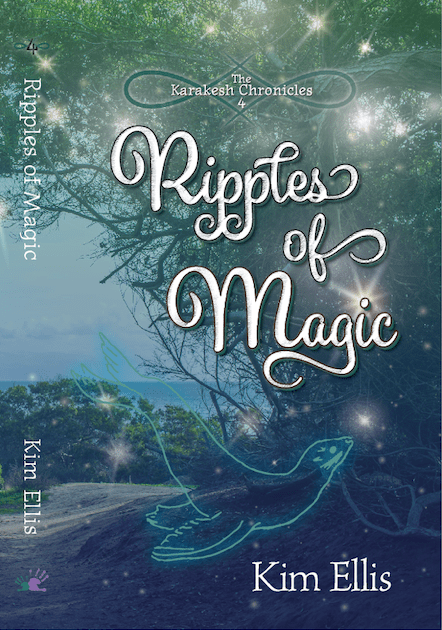
In the selkie legends, the male selkies transform into handsome men who come ashore to seek out and romance lonely women. Like Simead Nair in Ripples of Magic, the selkie is often bound by rules restricting how often he may turn human. Male selkies belong to the vast variety of faerie folk, and have the magical ability to charm women using their faerie glamour.
The most well known tale about the female selkie is the version I used in Awakening Magic. In the traditional story, the female selkie comes ashore and transforms into a human to bask in the sun or dance on the beach. A fisherman or seaman steals her sealskin. By possessing her sealskin, he traps the selkie in her human form and forces her to bow to his will. She remains a prisoner until she can retrieve the hidden sealskin and escape back to the sea.
The children of a selkie and a human union may have webbed fingers, like Demara in Ripples of Magic. It is said that selkie children are drawn to the sea, and that they will never drown. True fact: The people in the MacCodrum clan of the Outer Hebrides Islands have webbing, called syndactyly, between their fingers. They claim to be descendants of a selkie/human match.
Demara is the protagonist in Ripples of Magic, Book IV of the Karakesh Chronicles. She is the child of a union between a selkie man and a human woman. She feels like an outcast, not fitting in to either world, yet she longs to be a selkie like her father, and live with him in the sea.
excerpt from Chapter 2, Ripples of Magic:
By age twelve I was all too aware of the oddity of our family arrangement. On market days in the village, the children I met sometimes spoke about their fathers. I kept silent. Many fathers were miners who worked the day or night shift. There were farmers and craftsmen, bakers and tradesmen. Some fathers were drunkards, and a few were absent entirely. But none, none at all, were selkies who came out of the sea for three-day visits at the full moon.
Freyla was my best source of comfort and information.
“What am I supposed to do with these?” I asked her more than once, showing her my hands and feet. I spread out my fingers and toes to reveal the thin webbing of skin between them. “The village kids call me ‘Ducky.’” I wiped away a couple of loose tears.
“Those are your faerie badges of honor,” Freyla said.
All five books of the Karkesh Chronicles are available on Amazon and from Handersen Publishing










 Tangled Magic