A friend sent this book to me, a surprise in the mail. As I’m not a foodie or even a particularly enthusiastic cook, I wondered at the choice of reading material. However, I discovered some interesting connections as I read.
Madison spent twenty years at the Zen Center in San Francisco. I visited the Center in the early 1970s, because the sister of my then boyfriend was living there. She took us to the bakery where she was working. My memory is of Carol wearing a kerchief and apron and covered in flour. I seem to remember having a meal at the Center as well, with the three bowls as Madison describes, eating in silence, and then being coached on how to wipe out my dishes.
Madison mentions the garden at U.C. Santa Cruz. The renowned Alan Chadwick was resident head gardener there, and his theatrical voice could be heard directing students throughout the garden. I worked in the garden during the summer of 1969 and had at least one lunch there with Alan Chadwick.
“A Superb Horticulturalist of the 20th Century Alan Chadwick (1909-1980): English artist, Shakespearean actor, master horticulturalist, vitalist and visionary who revolutionized organic horticulture and inspired thousands of gardeners worldwide.” (chadwickarchive.org)
I have special memories of early mornings in the foggy garden, cutting carnations to be offered at a small stand for any members of the college community.
Madison’s memoir offers a somewhat disjointed, but interesting tour through the development of vegetarian cooking and her experiences as a chef.
Amazon’s description follows:
ABOUT AN ONION IN MY POCKET
From the author of Vegetarian Cooking for Everyone (“The Queen of Greens,” The Washington Post)—a warm, bracingly honest memoir that also gives us an insider’s look at the vegetarian movement.
Madison’s “insightful memoir” (The Wall Street Journal) is “a true delight to read as she uncovers her love for all real foods, peeling off layer by layer like an onion, recounting her own personal, culinary, and gardening experiences” (Lidia Bastianich).
Thanks to her beloved cookbooks and groundbreaking work as the chef at Greens Restaurant in San Francisco, Deborah Madison, though not a vegetarian herself, has long been revered as this country’s leading authority on vegetables.
She profoundly changed the way generations of Americans think about cooking with vegetables, helping to transform “vegetarian” from a dirty word into a mainstream way of eating. But before she became a household name, Madison spent almost twenty years as an ordained Buddhist priest, coming of age in the midst of counterculture San Francisco. In this charmingly intimate and refreshingly frank memoir, she tells her story—and with it the story of the vegetarian movement—or the very first time.
From her childhood in Big Ag Northern California to working in the kitchen of the then-new Chez Panisse, and from the birth of food TV to the age of green markets everywhere, An Onion in My Pocket is as much the story of the evolution of American foodways as it is the memoir of the woman at the forefront. It is a deeply personal look at the rise of vegetable-forward cooking, and a manifesto for how to eat well.
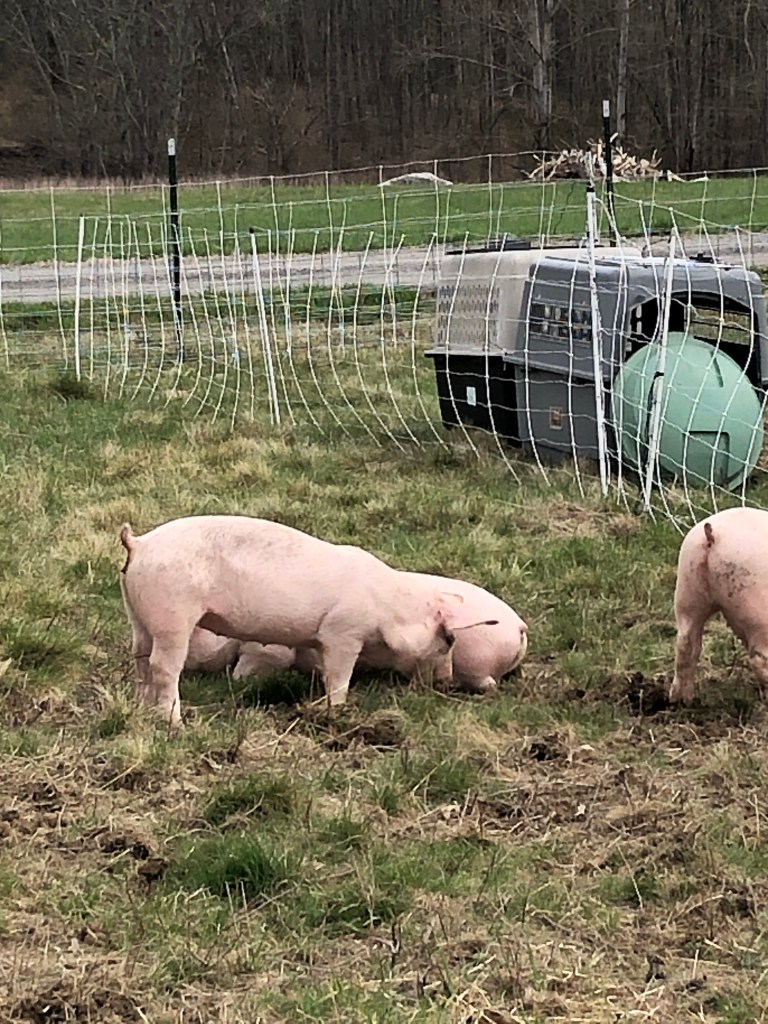
My godson is raising pigs. He’s made an enclosure for them—three pigs so far—in the field that belongs to his dad. They are contained by two fences; the inner fence is electrified by a solar battery; the outside fence is steel.
The pigs arrived in two dog crates. They were about the size of a medium dog, pinkish, with some black smudges. Two boys, one girl. They won’t have names because they are going to be meat.
The pigs have a job to do. It is all part of my godson’s plan. The porkers will cultivate the hard-packed earth of the field. They will fertilize it. And then crops can be planted. Right now, the soil is unworkable, even with a tractor tiller.
I didn’t know pigs were cultivators. Now that we’ve been watching them for a couple of days, I’m amazed at the power of their snouts. They easily turn over dense, rootbound chunks of earth with happy grunts and snorts. Apparently, there are good things to eat in the dirt, for they come up chewing. On roots? I don’t know. I’ll have to investigate further…
My research says that pigs eat dirt and the grubs, worms and decayed matter they find in it. The bacteria is good for their guts.
Meanwhile, the three piggies are doing an impressive job of plowing the field. They have a tunnel-shaped shelter filled with clean straw, a large pan of dry, compressed pig food, and a tub of water.
The carrots we tossed to them yesterday are still on the ground. They don’t love raw carrots. Wilbur of Charlotte’s Web rhapsodized about the ingredients of the slop bucket in his trough. Potato peelings, crusts of bread. I remember reading how the slop trickled down over Wilbur’s ears.
Some foods are toxic to pigs. The list includes leaves of cherry, apple, pear, plum and apricot trees, rhubarb leaves, avocado skin and pit, green potatoes, and tomato leaves and vine. Nothing moldy, slimy, or rotten.
I’m looking forward to morning pig visits, to see how their digging is coming along.
Enchantress of Numbers by Jennifer Chiaverini is a very LONG book about a fascinating woman, Augusta Ada King, Countess of Lovelace. I’m finally close to the conclusion, having experienced visceral reactions to Ada’s mother’s rigid parenting, her husband’s alignment with said mother Lady Byron, and the Victorian ideas about the weakness of the female body and brain.
I’ve been trying to remember where I encountered Ada before, because the main events of her life were vaguely familiar. Perhaps it was actually a film? In any case, here’s a brief biography:
Ada Lovelace (born Augusta Ada Byron; December 10, 1815- November 27, 1852) was an English mathematician who has been called the first computer programmer for writing an algorithm, or a set of operating instructions, for the early computing machine built by Charles Babbage in 1821. As the daughter of the famed English Romantic poet Lord Byron, her life has been characterized as a constant inner-struggle between logic, emotion, poetry, and mathematics during periods of failing health, obsessive gambling, and bursts of boundless energy.
My overall impression of Ada from Chiaverini’s book is of a supremely intelligent woman entrapped by Victorian social mores. It didn’t take me long to start cursing her mother for all the cruel restrictions she imposed on her one daughter. Of course, later on we learn of the very large skeleton in the Byron family’s closet that may explain some of the mother’s behavior.
Ada Lovelace’s childhood was far different from that of most aristocratic young women in the mid-1800s. Determined that her daughter not be influenced by her literary rockstar father’s promiscuous lifestyle and moody temperament, Lady Byron forbad Ada from reading poetry, allowing her instead to be tutored strictly in mathematics and science. Believing it would help her develop the self-control needed for deep analytic thought, Lady Byron would force young Ada to lie still for hours at a time.
For a woman of her time, though, Ada had more freedom than many others, being from a wealthy, aristocratic family and the daughter of the era’s most famous poet. She was able to pursue her passion for mathematics and did produce an original invention.
In 1842, Babbage asked Lovelace to translate from French into English a scholarly article on his calculating machine written by Italian military engineer Luigi Menabrea. Ada not only translated the article, but she also supplemented it with an elaborate analytical section she simply titled “Notes,” comprised of Note A to Note G. Lovelace’s seven notes, now revered as a milestone in the history of computers, contained what many consider to have been the first computer program—a structured set of instructions to be carried out by a machine. In her Note G, Lovelace describes an algorithm that would instruct Babbage’s Analytical Engine to accurately compute Bernoulli numbers. Today it is considered to have been the first algorithm specifically created to be implemented on a computer, and the reason Lovelace is often called the first computer programmer. Since Babbage never completed his Analytical Engine, Lovelace’s program was never tested. However, her process for having a machine repeat a series of instructions, called “looping,” remains a staple of computer programming today.
I wouldn’t say Enchantress of Numbers was a fabulous read, but I did finish the book. It is satisfying that Lovelace’s contribution to science is recognized.
How this book fell into my hands, I don’t recall now. It made a strong impression on me several years ago, memorable enough to be read again recently.
I have long been drawn to the Divine Feminine. She comes in so many guises, as Sophia, Shechinah, Mother God, and the Virgin Mary. In India, she has multiple aspects in the goddesses Shakti, Kali, Sarasvati, Lakshmi, and Durga. Greek mythology offers us Hera, Demeter, Aphrodite, and Athena. We have Kwan Yin and the White Tara.
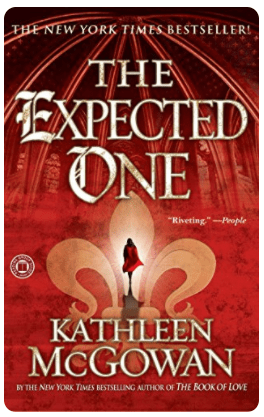
I grew up culturally Jewish, if not the child of religiously observant parents. I had negligible familiarity with the New Testament. So when I picked up The Expected One, I started out on a new and wild ride through early Christianity. And I met up with the controversy over Mary Magdalene.
Back in 325 A.D. at the Council of Nicaea, Roman Emperor Constantine I and church bishops chose which gospels and doctrines would be the official documents of the Catholic Church. They rejected some existing gospels, which resulted in a specific viewpoint. The chosen books of Matthew, Mark, Luke and John painted Mary Magdalene as a prostitute, a woman possessed by seven demons. One part of the story, though, couldn’t be eliminated: that Mary Magdalene was the first of the apostles to see the resurrected Jesus.
Other ancient documents came to light hundreds of years later. These told a different story, one that challenged the traditional Christian theology. In these writings, Mary Magdalene had a close relationship with Jesus. He chose her to continue his teaching. Joseph of Arimathea brought her safely to Alexandria, and from there, she traveled to southwestern France where she taught The Way. Her followers were known as Cathars, and their descendants live on in that part of France.
That’s one layer of the story. But the region’s folklore goes further, stating that Mary Magdalene was Jesus’s wife. They had children, whose descendants can trace their line back to one of the offspring. And this is the story McGowan tells in The Expected One.
This novel offers the fascinating and surprising journey of Maureen Paschal, writer and professor, who gets swept up in a quest for the gospel written by Mary Magdalene. If you choose to read the book, be sure to read the Afterword as well, in which the author includes parts of the Magdalene gospel she couldn’t fit into the novel.
I was so intrigued by this information that I bought The Gospel of Mary Magdalene by Jean-Yves Leloup.
Two more books by McGowan that continue the story are The Book of Love and The Poet Prince.
This question has come up more than once lately among my friends and writing colleagues. In this age of “fake news,” what have the sages said about truth? I thought I’d take a look.
truth
/tro͞oTH/
noun
1.the quality or state of being true: “he had to accept the truth of her accusation”
Rather than love, than money, than fame, give me truth. –Thoreau
…In Plato’s Cratylus, on the philosophy of language, Socrates says that aletheia (Greek, ‘truth’) is a compression of the phrase ‘a wandering that is divine.’ (I love this phrase) Since Plato, many thinkers have spoken of truth and God in the same breath, and truth has also been linked with concepts such as justice, power, and freedom. According to John the Apostle, Jesus said to the Jews: ‘And ye shall know the truth, and the truth shall make you free.’
…Today, God may be dying, but what about truth? Rudy Giuliani, Donald Trump’s personal lawyer, claimed that ‘truth isn’t truth,’ while Kellyanne Conway, Trump’s counselor, presented the public with what she called ‘alternative facts.’ Over in the U.K. in the run-up to the Brexit referendum, Michael Gove, then Minister of Justice and Lord Chancellor, opined that people ‘have had enough of experts.’
…Truth is a property not so much of thoughts and ideas but more properly of beliefs and assertions. But to believe or assert something is not enough to make it true, or else the claim that ‘to believe something makes it true’ would be just as true as the claim that ‘to believe something does not make it true.’ For centuries, philosophers have agreed that thought or language is true if it corresponds to an independent reality. For Aristotle, ‘to say that what is is, and what is not is not, is true.’ For Avicenna, truth is ‘what corresponds in the mind to what is outside it.’ And for Aquinas, it is ‘the adequation of things and the intellect’ (adæquatio rei et intellectus). Unfortunately for this so-called correspondence theory of truth, the mind does not perceive reality as it is, but only as it can, filtering, distorting, and interpreting it.
There’s the crux of the matter: our minds interpret “reality,” (whatever that is) and so we have the premise of the old Rashomon film: one event, multiple interpretations of the situation.
“The Rashomon effect describes how parties describe an event in a different and contradictory manner, which reflects their subjective interpretation and self-interested advocacy, rather than an objective truth.”— www.enwikipedia.org/wiki/Rashomon_effect
My quest for an answer quickly lands me in theology:
Here’s a simple definition drawn from what the Bible teaches: Truth is that which is consistent with the mind, will, character, glory, and being of God. Even more to the point: Truth is the self-expression of God. That is the biblical meaning of truth. Because the definition of truth flows from God, truth is theological.
Truth is also ontological—which is a fancy way of saying it is the way things really are. Reality is what it is because God declared it so and made it so. Therefore God is the author, source, determiner, governor, arbiter, ultimate standard, and final judge of all truth.
OK, but if we go with this, then who relays God’s truth to us? Trump? The Pope? Is anyone out there getting the word directly from God? The author of this article claims that truth is found in nature and in Scripture. He continues:
… Truth is not subjective, it is not a consensual cultural construct, and it is not an invalid, outdated, irrelevant concept. Truth is the self-expression of God. Truth is thus theological; it is the reality God has created and defined, and over which He rules. Truth is therefore a moral issue for every human being.
I can accept that truth and morality are closely connected. Onward!
From the Stanford Encyclopedia of Philosophy, we find a gathering of many thinkers on truth.
The problem of truth is in a way easy to state: what truths are, and what (if anything) makes them true. But this simple statement masks a great deal of controversy. Whether there is a metaphysical problem of truth at all, and if there is, what kind of theory might address it, are all standing issues in the theory of truth .* (for the complete outline, see below)
The basic idea of the correspondence theory is that what we believe or say is true if it corresponds to the way things actually are – to the facts.
The coherence theory:
A belief is true if and only if it is part of a coherent system of beliefs.
I don’t know about you, but this hasn’t gotten me much closer to the meaning of “truth.”
It is, as the Oxford Dictionary points out, easier to say what truth isn’t.