This morning, I happened upon this video on Youtube. Generally, I am not mathematically inclined, but this discussion of infinite patterns fascinated me. Some of the language went way over my head, however, I loved how the golden mean (1.618…) appeared in the patterns. The golden mean is the proportion that shows up in famous works of art.
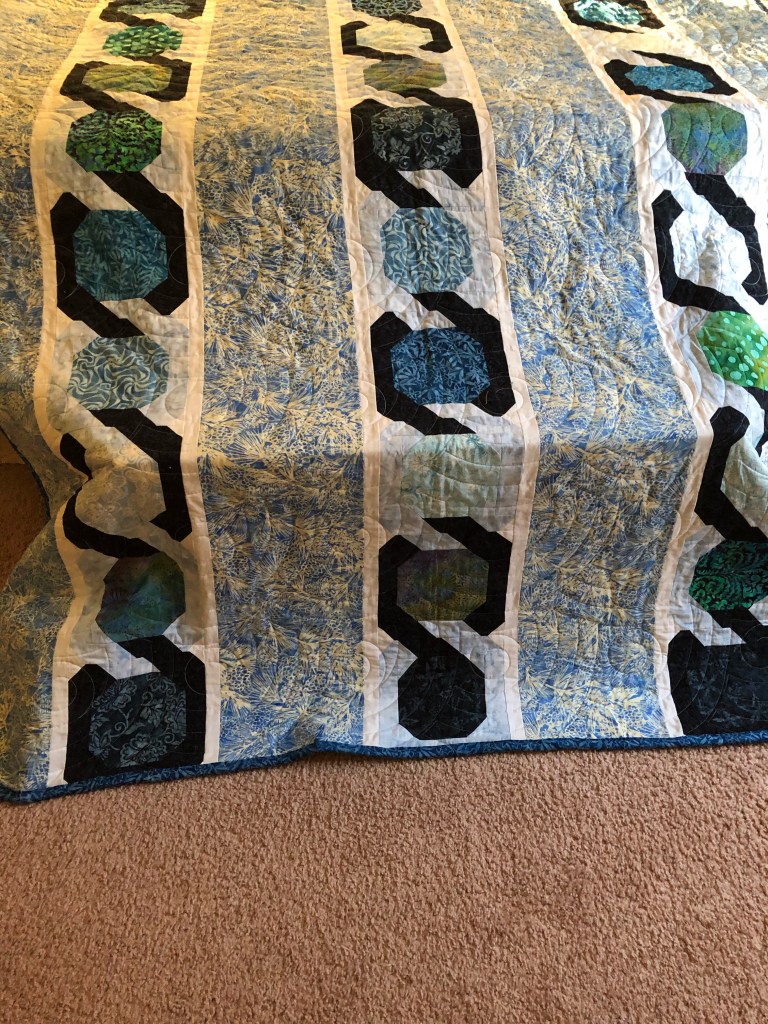
I am a quilter and quilters work with patterns. Most often, we sew together simple geometric shapes like squares, triangles, and rectangles to create larger designs. Circles and curves are trickier, and I’ve only attempted one quilt that involved those.
The underlying connections in the world, the spirals of shells and leaves, the snow crystals, the frost on windows, delight me when their structures are revealed.
The video about infinite patterns got me wondering if I could cut a template for dart and kite shapes, and make a quilt with an infinite pattern. This might be a recipe for insanity. I’ll think about it.
Three years ago, we got a dog. A little white dog. A dog who shed. In anticipation of white hair everywhere, I bought a fancy hand held vacuum (aka Dustbuster). Alas, the dog moved on. However, the vacuum remained as one of my favorite appliances.
This particular vacuum was powerful. It was rechargeable, too. We used it a lot: great for stairs and corners and crumbs under the table. After three years, though, the filter was battered and raggedy, so I ordered new ones that fit the Black and Decker model we had. I replaced the old filter with the new, and chucked the old one as it was too worn to keep.
The vacuum started acting up. We’d turn it on, it would run for 30 seconds, and turn off. Turn it on again, and it would work for maybe 4 seconds, and turn off. Was it the new filter?
I went online to the Black and Decker website and had a chat with someone at Support.
If the vacuum is less than two years old, we might replace it, she typed. Do you have the receipt?
I might, I answered, but it would be in the file cabinet in the storage unit. I’d have to look. But I’m pretty sure it’s more than three years old.
The batteries only work for three or four years, she added.
Can I get a new battery? I asked.
No, they’re not replaceable, she wrote.
So what am I supposed to do? I was beginning to steam.
You’d have to buy a new unit.
Now I was truly outraged.
You do realize how ridiculous this is? I banged out on my keyboard. I’m supposed to throw this thing away so it sits in a landfill for a million years, because it’s made with a non-replaceable battery?
I’m sorry, she typed. I understand.
We signed off.
So all the people who bought hand held cordless vacuums with rechargeable batteries in 2017 can expect them to die soon. I keep picturing the county landfill piled high with dead vacuums. So wasteful. It’s infuriating. I’m sticking to vacuums with cords from now on.
Meanwhile, do I really throw out this dead vacuum?
In my family, there is a book that is as significant as a Bible. It is The Melendy Family by Elizabeth Enright, first published in 1941. Before I was born, my sister, Jan, was the first child to snuggle next to our mother as she read aloud the adventures of the four Melendy children: Mona (girl, 14), Rush (boy, 12), Randy (girl,10), and Oliver (6).
As Jan remembers, she burst into tears when our mother finished reading the last paragraph. Jan was so distraught that Mom turned back to the first chapter and started the book again.
“It would have to rain today,”said Rush, lying flat on his back in front of the fire. “On a Saturday. Certainly. Naturally. Of course. What else would you expect? Good weather is for Monday Tuesday Wednesday Thursday Friday; and rain’s for Saturday and Sunday, and Christmas vacation and Easter.”
For me, that first line is more evocative than the March’s “Christmas won’t be Christmas without any presents.”
Mom loved reading aloud, so I got the Melendys next. She was sad when I became an independent reader and wanted to read on my own. My cousin, Patty, only two months older, was also a Melendy lover. Together we acted out Melendy stories in our fantasy play. I know I read the book at least ten times before I turned eleven. Years later, I read The Melendy Family to my daughter. She has continued the tradition, reading the book to her two girls.
The Melendy Family actually contains three smaller books: The Saturdays, The Four-Story Mistake, and Then There Were Five. In The Saturdays, the Melendys are living in New York City during the beginning of World War II. Mr. Melendy works for the government in some unspecified capacity. In the first chapter of this book, the children decide to pool their allowances so that each child can do something special on his or her Saturday.
It amazes me now, that eighty years ago, a ten-year-old child, Randy, was allowed to wander around New York City alone. Eventually, though, it is decided that the children should all go out together.
The Four-Story Mistake begins with the family moving upstate. I have wondered many times whether the Melendy’s relocation to a quirky house near a small Hudson Valley village drew me to live in a similar place.
I was pregnant with my second child when we landed at my husband’s family farm. The Melendys had a brook on their property. I had the Wallkill River below the house. Later, after a couple of moves, I bought a house with a nameless creek in the backyard. There, my daughter met up with a luna moth, echoing Oliver’s infatuation with the very same creature.
For the past few days, I’ve been rereading The Melendy Family. It’s a joy to reconnect with the book, but also a revelation. Enright is a fine author. Her prose is clean and lyrical, and she knows children. For example, here is Rush getting ready for his Saturday adventure:
After lunch, Rush had to hurry. Randy came in as hewas furiously combing his hair and trying to make it lie flat.
“What have you put on it now?” asked Randy, sniffing curiously.
“On what? My hair? Oh, some of Mona’s face cream,” grinned Rush. “I thought maybe it would make it straight. But I guess it won’t.”
“Mona will kill you if she finds out. You’d better go before she gets a chance to smell you.”
I have often thought that, when I’m quite senile, I will confuse my own stories and family with the Melendys. Without a doubt, author Elizabeth Enright and The Melendy Family shaped me as a writer for children.
The Book of Longings by Sue Monk Kidd was a delicious book, so good that I couldn’t stay away from it and I also didn’t want it to end. Of course, I pretty much knew at least part of the ending, as it was the story of Jesus’s wife, Ana.
I imagine that idea alone—that Jesus had a wife–offended plenty of potential readers. However, I’ve always found the claim that Jesus was a celibate bachelor hard to believe. Jesus was a Jew, and Jewish men got married.
Author Kidd invents Ana, a young girl passionate about writing and study. At the book’s outset, I was skeptical that such a person would have existed during Herod’s reign. The power of the story soon left my disbelief behind. By the time Ana meets Jesus, she is a learned scholar and chronicler of the lives of women.
In Kidd’s words:
I saw Ana not only as the wife of Jesus, but as a woman with her own quest—that of following her longings in pursuit of the largeness inside herself. I saw her, too, as a woman able to become not only Jesus’s wife, but his partner.
Kidd’s extensive research gives the book credibility. I was most interested in the Therapeutae. As Kidd explains, this was
a real monastic-like community, near Lake Mareotis in Egypt, where Jewish philosophers devoted themselves to prayer and study and a sophisticated allegorical interpretation of Scripture…However, the Therapeutae’s practice of asceticism and solitude was far more prevalent and intense than I describe.
Delving further, I found this information from Britannica:
Therapeutae, Greek Therapeutai (“Healers,” or “Attendants”), singular Therapeutes, Jewish sect of ascetics closely resembling the Essenes, believed to have settled on the shores of Lake Mareotis in the vicinity of Alexandria, Egypt, during the 1st century AD. The only original account of this community is given in De vita contemplativa (On the Contemplative Life), attributed to Philo of Alexandria. Their origin and fate are both unknown. The sect was unusually severe in discipline and mode of life. According to Philo, the members, both men and women, devoted their time to prayer and study. They prayed twice every day, at dawn and at evening, the interval between being spent entirely on spiritual exercise. They read the Holy Scriptures, from which they sought wisdom by treating them as allegorical, believing that the words of the literal text were symbols of something hidden. Attendance to bodily needs, such as food, was entirely relegated to the hours of darkness.
Bimi Lightfoot, ten years old, knows that his mother was a faerie. He knows he doesn’t fit in with the beach family who adopted him. Someday, he promises himself, he’ll find his mother and ask her who his father is. When Bimi’s faerie cousin scoops him off the beach to steal back a horse, Bimi’s chance to find the answers becomes a reality.
Once again, in Book V of the Karakesh Chronicles, the protagonist’s quest leads him into adventure, danger, and friendship.
If you’ve read any of my other Karakesh Chronicles, you’ll know that the Kingdom of Karakesh is a land of magic and danger. The young characters encounter some fearsome faerie monsters, such as the dreaded fachan, whose glance may stop a heart, or the bunyip, a bloodthirsty dweller in rivers.
Book I, Tangled in Magic: Agatha sets out to find her twin brother, Malcolm, held prisoner by a warlock.
Book II, Guided by Magic: Two sisters struggle to unite and discover their destinies.
Book III, Awakening Magic: Prince Emric must avert a war between the faeries and dwarves.
Book IV, Ripples of Magic: Demara, a half selkie (Seal Person) hopes to join her selkie father in the sea.
Four Karakesh Chronicles are available on Amazon at