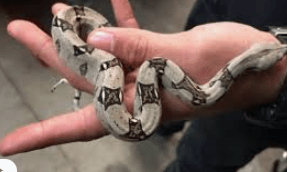
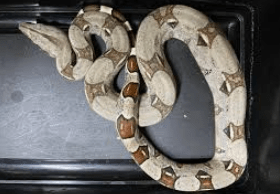
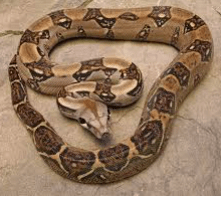
Her name was Kali. She joined my second grade classroom when she was only about as long as my forearm, a gift from a student. His father raised Colombian rosy boas in their basement. The dad must have done it well, since a full-grown pair had been happy enough to mate and start a family.
Unlike some, I don’t have problems with (non-venomous) snakes. I’ve always enjoyed the feel of them. Their bodies are so smooth and cool. The patterns on snake’s skins are often beautiful. I like the pressure of the constrictor’s body as it glides along my arm. So I was delighted to have Kali.
Kali ate mice. Live mice. In order to feed her, I kept a cage of mice in the classroom. Be assured, I never dropped a mouse in her tank when the students were in school. Even so, it was with a combination of horror and fascination that I watched Kali zero in on her meal, snatch it, and squeeze. Then began the slow process of swallowing the mouse headfirst.
All of us in my class enjoyed the snake. Those at home–not so much. My family tolerated Kali when I had to bring her home during vacations. The mouse cage stayed in the downstairs half-bath, on top of the toilet tank. They smelled.
Once, when I had stayed home sick, my substitute teacher, Mrs. D., called me. Mrs. D. was one of the most competent substitutes in the district. She was tough, and no student behavior was known to faze her. However, the day she called, Mrs. D. was freaking out—and not because of the snake. The mother mouse had eaten her babies. I was stuck at home with a cold–there wasn’t much I could do. Either the mother mouse had felt her family was threatened, or the babies weren’t healthy. Poor Mrs. D.! I imagine she thought twice about accepting a sub day in my classroom after that.
Kali got one mouse a week. And Kali grew. She’d reached about three feet in length when our relationship came to an abrupt end. One morning before the kids arrived, I fed her a mouse. Then I refreshed the water in her dish. As I returned the dish to her tank, Kali struck at my hand. Rosy boas don’t have fangs, but they do have rows of needle-sharp backward-pointing teeth. Both snake and I recoiled with surprise.
When I spoke about this with a knowledgeable snake person, I learned that Kali was now a two-mouse snake. I had been feeding her too often. She was bigger and hungrier. My hand must have smelled like the mouse I had held, so she went after it. The bite wasn’t big or serious, but I had to reconsider: How important was it to have a rather large snake in the classroom? It was time to part ways.
Kali’s robust health and size brought a good price when I traded her in at the pet shop. In her place, I got some fish, colorful gravel, and a filter for the tank. The fish were soothing to watch. The gurgle of the filter was also a pleasant noise. Best of all, I didn’t need to keep a cage of smelly mice.
That was my last pet snake.
Here’s an interesting article about why animals sometimes kill their babies.
The Book of Longings by Sue Monk Kidd was a delicious book, so good that I couldn’t stay away from it and I also didn’t want it to end. Of course, I pretty much knew at least part of the ending, as it was the story of Jesus’s wife, Ana.
I imagine that idea alone—that Jesus had a wife–offended plenty of potential readers. However, I’ve always found the claim that Jesus was a celibate bachelor hard to believe. Jesus was a Jew, and Jewish men got married.
Author Kidd invents Ana, a young girl passionate about writing and study. At the book’s outset, I was skeptical that such a person would have existed during Herod’s reign. The power of the story soon left my disbelief behind. By the time Ana meets Jesus, she is a learned scholar and chronicler of the lives of women.
In Kidd’s words:
I saw Ana not only as the wife of Jesus, but as a woman with her own quest—that of following her longings in pursuit of the largeness inside herself. I saw her, too, as a woman able to become not only Jesus’s wife, but his partner.
Kidd’s extensive research gives the book credibility. I was most interested in the Therapeutae. As Kidd explains, this was
a real monastic-like community, near Lake Mareotis in Egypt, where Jewish philosophers devoted themselves to prayer and study and a sophisticated allegorical interpretation of Scripture…However, the Therapeutae’s practice of asceticism and solitude was far more prevalent and intense than I describe.
Delving further, I found this information from Britannica:
Therapeutae, Greek Therapeutai (“Healers,” or “Attendants”), singular Therapeutes, Jewish sect of ascetics closely resembling the Essenes, believed to have settled on the shores of Lake Mareotis in the vicinity of Alexandria, Egypt, during the 1st century AD. The only original account of this community is given in De vita contemplativa (On the Contemplative Life), attributed to Philo of Alexandria. Their origin and fate are both unknown. The sect was unusually severe in discipline and mode of life. According to Philo, the members, both men and women, devoted their time to prayer and study. They prayed twice every day, at dawn and at evening, the interval between being spent entirely on spiritual exercise. They read the Holy Scriptures, from which they sought wisdom by treating them as allegorical, believing that the words of the literal text were symbols of something hidden. Attendance to bodily needs, such as food, was entirely relegated to the hours of darkness.
Bimi Lightfoot, ten years old, knows that his mother was a faerie. He knows he doesn’t fit in with the beach family who adopted him. Someday, he promises himself, he’ll find his mother and ask her who his father is. When Bimi’s faerie cousin scoops him off the beach to steal back a horse, Bimi’s chance to find the answers becomes a reality.
Once again, in Book V of the Karakesh Chronicles, the protagonist’s quest leads him into adventure, danger, and friendship.
If you’ve read any of my other Karakesh Chronicles, you’ll know that the Kingdom of Karakesh is a land of magic and danger. The young characters encounter some fearsome faerie monsters, such as the dreaded fachan, whose glance may stop a heart, or the bunyip, a bloodthirsty dweller in rivers.
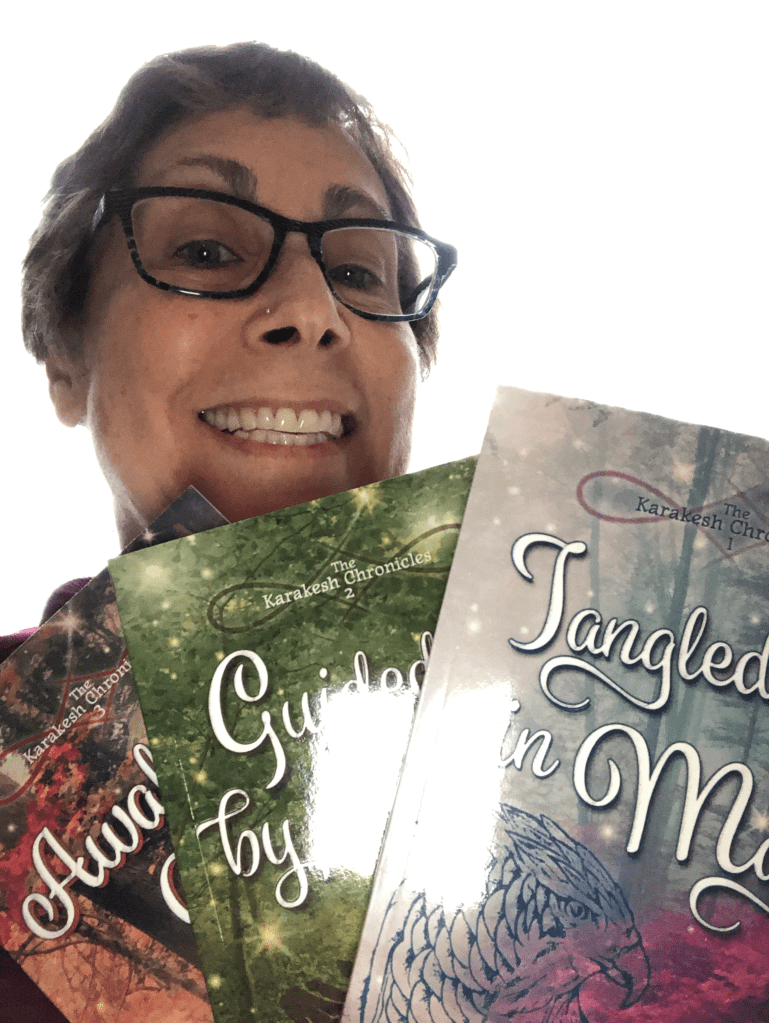
Book I, Tangled in Magic: Agatha sets out to find her twin brother, Malcolm, held prisoner by a warlock.
Book II, Guided by Magic: Two sisters struggle to unite and discover their destinies.
Book III, Awakening Magic: Prince Emric must avert a war between the faeries and dwarves.
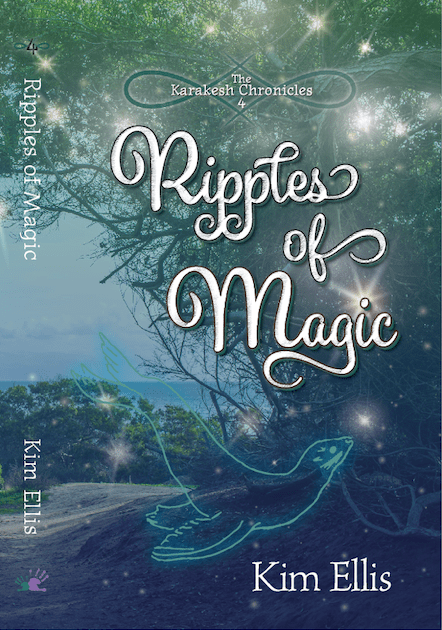
Book IV, Ripples of Magic: Demara, a half selkie (Seal Person) hopes to join her selkie father in the sea.
Four Karakesh Chronicles are available on Amazon at
The Mohonk Testimonial Gateway was built in 1907-8 to commemorate the 50th wedding anniversary of the co-founders of Mohonk Mountain House, Albert Keith Smiley and his wife Eliza Phelps Smiley.
Opened to the public last May, the Gateway Trailhead offers access to carriage roads and trails in the Foothills of the Shwangunks.
Lately it is my favorite place to walk, and well worth the price of the Mohonk Preserve membership.
Starting at the parking lot, we pass through a bit of wooded area and then, skirting the Gatehouse, we emerge onto the allee, a straight carriage road lined with venerable pin oaks. Immediately on the right is a pond where frogs galump and we may see a great blue heron.
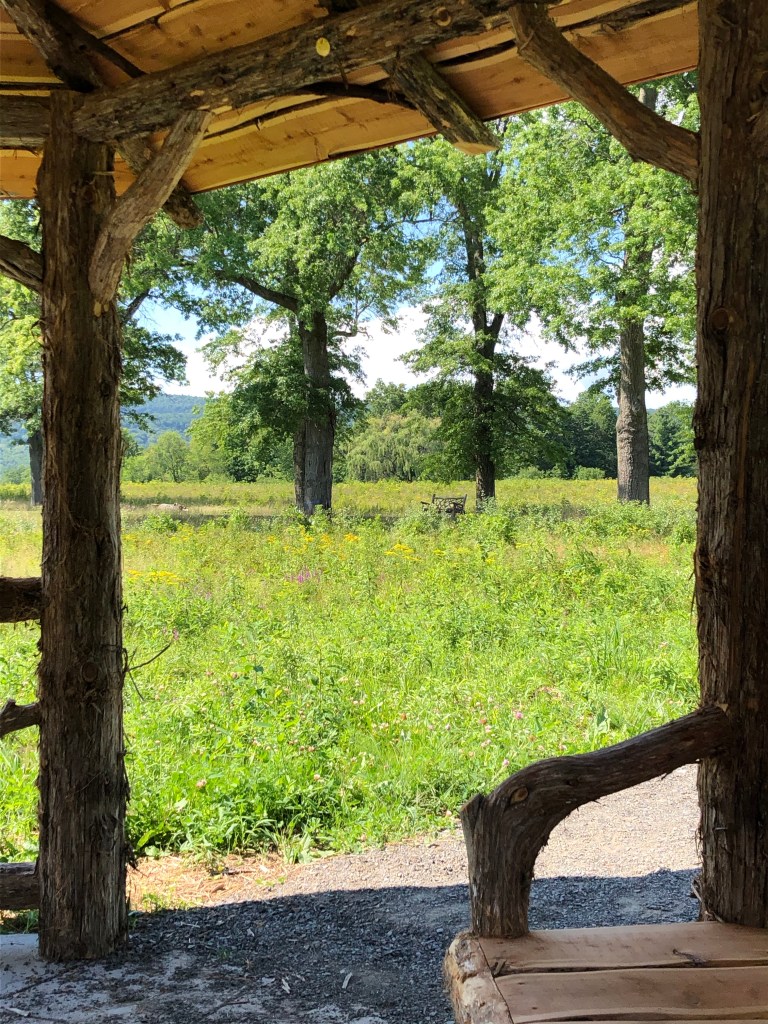
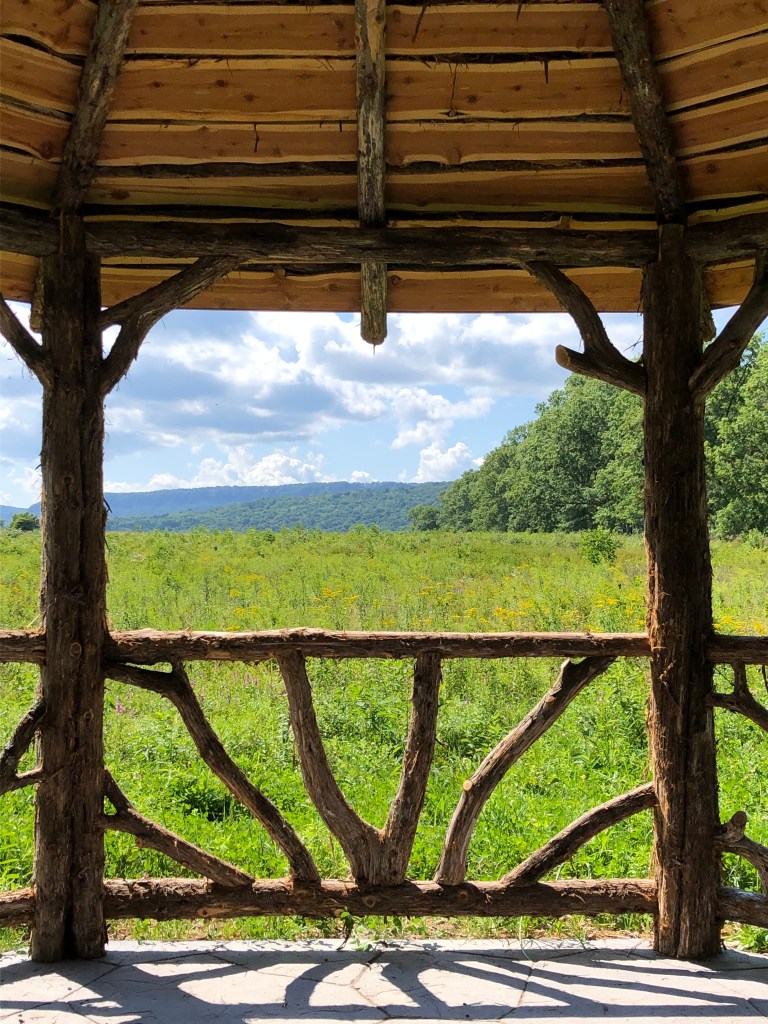
To the left is a gazebo with a lovely view across the meadow. From there, we can count monarch butterflies and take in the curve of the mountains.
The Lenape Bridge at the end of the allee is under construction, so people are detoured through a field and across the road where we can rejoin the carriage road. Here is presented a choice: straight ahead across the farm fields where black cows graze, or to the right toward more woods.
On our most recent walk, we showed up in the evening, when the fields were exhaling the day’s breath. The fragrance was full of grass and wildflowers and the life of the land.
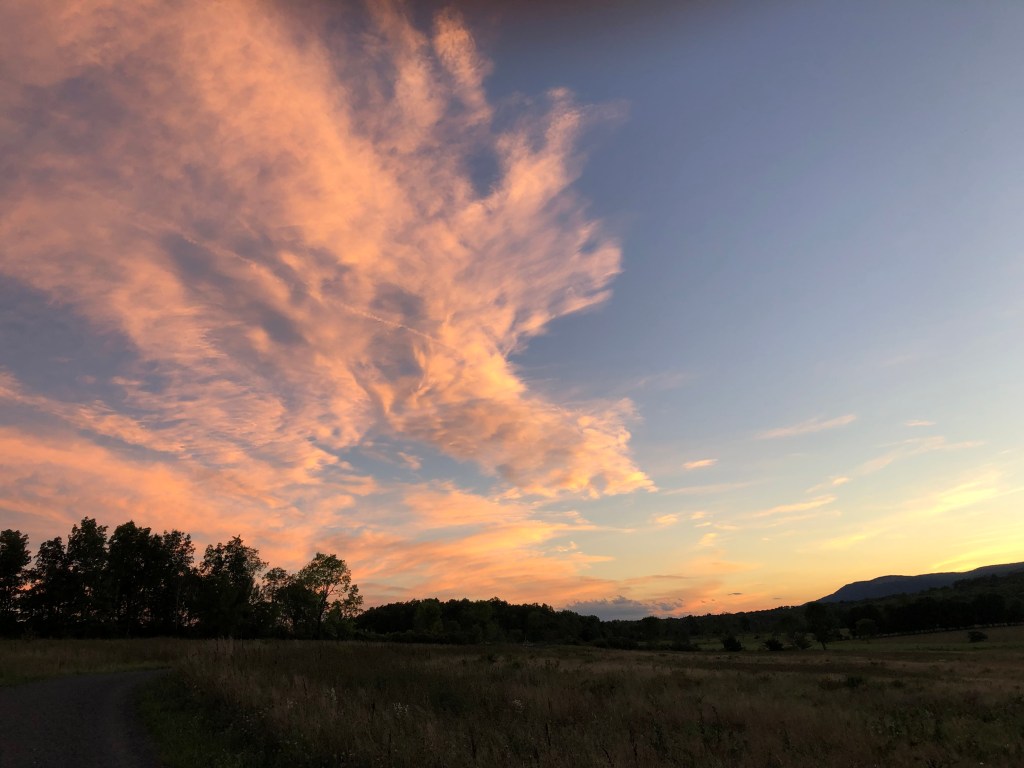
After a day inside the apartment, the Preserve offered space and air and a fabulous sunset.
Lately my husband and I have been sorting through our bins of stuff in an effort to reduce the amount in our storage unit. This is a COVID-inspired activity that actually produces a positive result.
While digging around in a bin of my old teaching materials and my kids’ artwork, I found the little book More Anguished English by Richard Lederer. The book’s subtitle reads: An expose of embarrassing, excruciating, and egregious errors in English. I bought this book second hand at least twenty-five years ago. Finding it again brought back a vivid memory of the time I first read it.
It was spring break and I’d rented a house on Chincoteague Island. I had my two kids and two of their friends with me. The kids were finishing dinner and I picked up the book. Soon I was laughing so hard that I couldn’t read it aloud to them.
Some examples from students’ essays*:
Rambo was a French poet.
A great Jewish leader in Scotland was Rabbi Burn.s
A harp is a nude piano. (This image delights me every time.)
As I reread pages a quarter of a century later, I wasn’t as amused. In fact, I found myself feeling compassion for the beleaguered writers, and slightly irritated that the author and my former self made fun at their expense. My change of attitude was rooted in the eight years I taught English as a new language (ENL) to children from kindergarten through fifth grade.
English is a difficult, often nonsensical language. A famous example of its challenges is the variation on /ough/: rough, through, slough(two meanings, two pronunciations), though. Sometimes English seems to have more exceptions than reliable patterns.
My experience as an ENL teacher changed the way I read the “bloopers” in More Anguished English. Some errors were caused by mishearing, such as The big artery on your neck is called the jocular vein. Other mistakes were misspellings: At night we stayed in a youth hostile.
Instead of finding humor in the errors, I found that my heart hurt a bit for the authors struggling to communicate in a challenging language. Whether English is a first language or a new language, learning it isn’t easy. How many native speakers are confused by there, they’re, and their? Were and where?
I’ve always admired Michelle Obama for her strength, integrity, and comportment as the First Lady. The Michelle Obama podcast reveals these qualities and many more. In the first episode, Michelle talks with Barack Obama about community. It is a delight to hear these two dedicated and intelligent people in a meaningful conversation.
I’ve listened to every episode so far. The topics have ranged from women’s health issues to friendships to marriage. The most recent (9/10, as of this writing) involved a discussion with Michelle Obama’s mentees, young black women who held internships with her at the White House. The mentees speak so thoughtfully as they reflect on their experiences at the White House. It is obvious that they have modeled themselves after their mentor.
If you haven’t had a chance to listen to this podcast, I urge you to tune in. It’s available FOR FREE on the Spotify app, also free.
The Sawmill Creek behind our apartment complex flows into the pond on the college campus across the road. From there, it empties into the Wallkill River, the only north-flowing river in the U.S. The Wallkill meets Rondout Creek near Rosendale, and their joined waters enter the Hudson River at Kingston.
This spring, the creek overflowed a few times, coming perilously close to the footings of the apartments. Then, under the heat of summer, it petered out and became full of grass.
One early morning, the rumbling of machinery surprised us. We stepped out on our balcony to watch what was the beginning of a major landscaping project. The guy running the excavator was amazing. He dug out the creek bed. If he encountered rocks, he picked them up and dropped them into line on the far side of the trench. He used the shovel’s curved back to nudge the boulders into place, looking like a giraffe mother helping its newborn.
Another guy drove the bulldozer, picking up the dirt and smoothing it out on the side closest to the apartment buildings.
All this landscaping activity has been great entertainment for the past week. In between pauses caused by rainstorms, the workers have completed the trench where the creek will run, laid thick black plastic along it, and dumped rocks on top of the plastic.
Eventually, the drainage pipes from the apartment gutters will be buried, the plastic will be covered over, and our lovely Sawmill Creek will again flow freely to the Hudson.













 Tangled Magic