Keeping Sane

I’m a maker of art.  I always have been.  Excluding folkdancing, I’m most happy when I’m working on a project.  Since the onset of my husband’s dementia, I’ve found escape and solace in quilting and writing, with occasional forays into drawing.

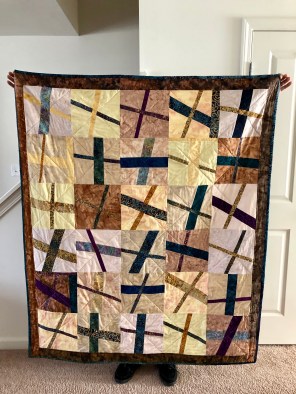
Sometimes I coerce my husband into sewing a quilt project with me.  fullsizeoutput_2234

We made this quilt for dear friends in California.

After mailing that off, I took a couple of days to make placemats for a beekeeper we know.

And today I’ve returned to my big project, a king size quilt for our bedroom.  I should ultimately have 94 fan blocks.  I’m about halfway there.  My workspace looks chaotic, but it’s really quite organized.

fullsizeoutput_2230

More quilter’s tools:

These projects keep me feeling productive and give me focus and satisfaction, rather than wallowing in a caregiver’s emotional stew.

And it’s so much fun to surprise someone with a quilt.


Discovering My Inner Mother Bear

My husband is a nice guy. He’s thoughtful and helpful and generous. He has a big heart. In spite of the dementia, or maybe because of it, he’s become even more helpful. Several times a day I hear, “Is there anything I can help you with?” When we’re out doing errands, I’ll think he’s walking behind me and find he’s vanished. In a minute or two, he’ll reappear. “I was helping a woman with her bags,” or “I was holding the door for that mother with the stroller.”

stroller

However, he does have his weak points. One of these is his impaired sense of rhythm. Add to that twenty-five too many pounds, difficulty following a dance pattern, moderate memory loss, and you’ve got a guy who is not a dancer.

dementia 2

My husband and I have been going to community folkdance sessions for perhaps five years.  Most of the dancers are over 60.  Some are beginners, and some, like myself, are more advanced.  Many have been attending Thursday dance for longer, and yet still only do the basic, simple dances.
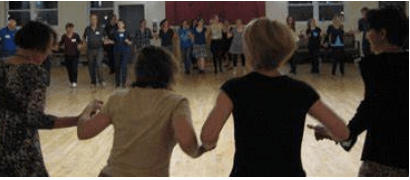
folkdancers

Enter Ari, an experienced dancer with a low tolerance level.  A few weeks ago, he told me that I should tell my husband not to try the harder dances.  I balked.  “Don’t you hold sway over your husband?” he demanded.

I was upset. Normally I back away from confrontation; I abhor and fear conflict. Yet  I called Ari out into the hall and we had words.  Then I cried in the bathroom for a few minutes.  But next time he came to dance, it got worse.

Ari was doing a tricky dance next to my husband, who couldn’t keep up.  “This dance is too hard for you,” I heard Ari say. ” You should sit down.” (Imagine what the world might be like if we told children, “Don’t do this, it’s too hard for you.”)

“Screw you!” my husband replied, to his credit.

Ari huffed his irritation.  He threw up his hands dramatically, drawing everyone’s attention, and went to a different part of the line.

Which is what he should have done in the first place.

To my knowledge, there has always been an unspoken folkdance etiquette: If you don’t want to dance next to someone, you move away.  Simple.

You don’t tell someone not to dance.  This isn’t a performing dance troupe.  It’s a bunch of seniors who love folkdancing.

Two of my friends supported me in confronting Ari.  But his actions had tapped a huge, complex emotional response in me.  I was furious that anyone would be unkind to my sweet-tempered, ill husband.  And I was hurt by Ari’s lack of understanding. This small incident brought out all the anger, sorrow, frustration, loneliness, and guilt I carry as a caregiver, as well as a new protective instinct.

What words were exchanged escape me now.  I was too upset.  I only remember the last thing I said.  “That was mean!” I snarled, as I threw my belongings together and left. My husband trailed after me, totally confused as to why I was so upset and leaving early.

The incident had me in tears on and off for a few days.  I realized that Ari and I had the same desire: to enjoy dancing without someone’s interference. Nevertheless, he “made a bad choice,” as we say to kids.

By report, Ari still doesn’t seem to feel much empathy for my husband, or for me as a 24/7 caregiver who just wants to enjoy folkdancing.  The highlight of my week is being able to dance without having to monitor my husband for an afternoon.  At the dance center, he’s safe, he’s active, and people are accepting and good to him. Well, with one exception.*

I will not give up attending folkdance with my husband.  The experience, though, has scarred me. But it also surprised me, because I discovered how protective I am.  Mother bear, indeed!

mother bear

Update: Ari apologized.


The Goodness of Clay

clay 1

For the past three years or so, I’ve been searching for an activity that my husband with dementia would enjoy.  In his healthy days, he was good with machines.  He liked fixing chair legs and picture frames in his workshop.  He built bookshelves.  He had a shed full of tools and supplies, from a radial arm saw to a lathe, and a cupboard brimming with boxes of nails and screws.

Two events put an end to his grand projects.  We moved away from the house with the workshop and he was diagnosed with mild vascular dementia.

First, I tried to interest him in sewing a quilt.  Since he liked machines, maybe this would engage him.  I supervised and he measured and sewed.

IMG_3427

He made a beautiful quilt that today graces a wall of our living room.  However, that was five years ago.  Now we make quilts together. I do all the measuring and he sews the seams after I’ve set them up for him.  I get the feeling that he’s not really interested and is just sewing to indulge me.

Another activity that I tried was jigsaw puzzles.  I hoped he’d work on them while I was otherwise occupied, doing desk work or writing.  No, he has color weakness, and this made doing puzzles more of a frustration than a pleasure.

Coloring mandalas with colored pencils was a total bust.  So was making cloth baskets.

A friend who is a potter suggested my husband might like to work with clay.  She has a studio and, though semi-retired, still teaches a few students.

When we arrived for our first session, we each got a pound of gray clay.  Our friend showed us how to bang out the air bubbles.  Then my guy dove in. For an hour or more, he shaped the clay.  I’d never seen him so absorbed in anything creative.  This first lesson, he made a cat-like animal.  The second session, he made a coil pot with a lid.

clay 2

The third time, he rolled out a thin slab and curved it up into a dish that he stamped with designs.

clay 3

I’ve since wondered what is different about working with clay.  Maybe it is the sensuality of the medium.  Maybe he feels powerful having an effect on a glob of mud, and creating something.  In most other aspects of his life with dementia, he’s dependent on me.    He can’t drive, can’t remember what day it is, or what we did that morning.  I can only imagine how he feels: powerless, frustrated, confused.

Whatever the reason, he loves the clay.  And I’m thrilled to have found a craft that makes him happy.

Where Sorrow Resides

sorrow

Years ago I read that sorrow affects the lungs.  The idea remained buried in a back drawer of my mind.  Recently, though, I’ve had cause to unearth this notion while dealing with a persistent health issue.

In December, while vacationing with my husband in California, I caught a bad cold.  Normally I would rest at home and kick such a virus in a few days.  My illness was exacerbated by an upended routine, long days of travel, and demands to be present for West Coast family gatherings during the holidays.

Three days before our flight back to New York, I realized that it was more than a cold.  My chest felt like it was imploding.  At the local urgent care I was given a “Z-pack” for bronchitis.  Things got a little better until the flight home, when the symptoms got worse. Back I went to another urgent care on a Sunday and was given another antibiotic.

Eight weeks later, I was still wheezing and tired, with stuffed sinuses.  The ENT specialist that I visited said I had a sinus infection and–you guessed it–gave me a third round of antibiotics.

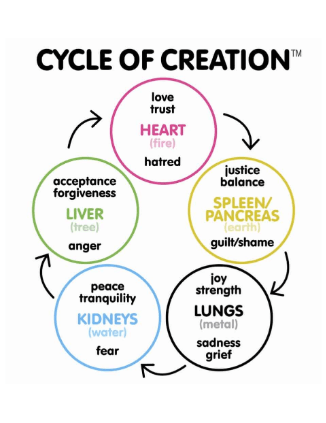
The point of this narrative is this: in Traditional Chinese medicine, lung illnesses are connected with grief.

cycle of creation

ottowaholisticwellness.ca

I’m a grieving spouse, having lost the future I’d imagined with a spouse who is no longer the person I married.  Although I keep active and engaged with caregiving and many activities, I live with an underlying river of sadness, that springs up into my eyes often, sometimes with the slightest surprising provocation.

Grief  must be expressed to let it go.  We can’t measure the severity of loss with instruments, but only by how strongly it is felt. Unexpressed grief harms the lungs.  Coupled with the all the other emotions that caregiving can produce (fear, anger, guilt–see above diagram), caregivers’ health may be threatened.

So how do caregivers cope and keep illness at bay?  Exercise, meditation, support groups, Emotional Freedom Technique (EFT)*, time with friends, religious practice: all of these help me stay healthy.

lungs in chinese medicine


The website below was enlightening.

https://www.chinesemedicineliving.com/philosophy/the-emotions/grief-the-lungs/

*more about this in another blog

Monkey Mind, Meditation, and Caregiving

howler monkeys

You’ve heard the expression “monkey mind” when referring to the distracting thoughts that jump like monkeys when one is attempting to be still.  These days, when I sit to meditate, I have an entire troupe of howler monkeys yammering and flinging themselves about in my mind.  I’ve been meditating for a long time, so I know the guidelines: when you notice you’re off the mantra, gently come back to it.

Maybe it was the familiarity of the process, or maybe it was the overflow of emotions, worries, plans, and obligations that have beset me since I’ve become a caregiver.  Whatever the cause, my former simple practice of repeating “Om namah shivaya” (the mantra of Siddha Yoga, translated as “I honor the Light within”) wasn’t working.

A teacher of a class we took introduced me to a different type of meditation/prayer. This method has proved to be helpful for me.  I’m mostly attracted to the feminine aspect of the Great Mystery/Higher Power, so I’ve amended the sentence “Be still and know that I am God” to “Be still and know that I am the Mother and the Light.”  For me, “Mother” encompasses divine love and compassion, while “Light” represents wisdom and clarity.  By offering my mind more to do, I’ve found a way to move those howler monkeys to a distant tree.

Here’s my practice:

I hold my left hand in chin mudra, with thumb and forefinger touching.  The fingers on my right hand track the mantra and prayer by gently pressing my thigh as I silently go through the words, like this:

Inhale: Om namah shivaya

Exhale: Thumb–Be still and know that I am the Mother and the Light.

Inhale: Om namah shivaya

Exhale: Forefinger–Be still and know that I am.

Inhale: Om namah shivaya

Exhale: Middle finger–Be still and know.

Inhale: Om namah shivaya

Exhale: Fourth finger: Be still and feel my presence.

Inhale: Om namah shivaya

Exhale: Pinky–Be grateful.

Note that the mantra can be any word or phrase that has meaning for you and focuses on Spirit. In the midst of full-time caregiving, this process has helped me recapture the deeper calm and solace of meditation.

Do let me know if you try this.  I’m curious to hear if it works for others.

virgen de guadalipe

Dog Days and Dementia

weimar pose


I can’t decide if comparing my husband/care-receiver to a dog is funny or pathetic.  However, the similarities between pets’ care and behavior and my guy are hard to dismiss.  Here are some:

  • He shadows me everywhere, wanting to be by my side.
  • He gets anxious when he doesn’t know where I am.
  • He loves to go for car rides.
  • He sneaks food if I’m not watching.
  • He makes messes that I clean up.
  • He barks at other dogs (true).
  • He’s loving and loyal.
  • He’s grateful for my attention.

Many other caregivers, on reading this, will deem me fortunate.  Dementia patients can be cantankerous and ungrateful.  As yet, my dementia dog-man is agreeable and appreciative, which makes the caregiving easier.

When we’re out walking and we see someone with a dog, he says, “I’m glad we don’t have a dog.  They’re so much work.”

I say a silent, “Amen to that!”

tired Irish wolf


Disappointment

meditator 3

I thought I had everything arranged.  An older gentleman acquaintance would come each Sunday to keep my guy company while I went to my writing group.  He seemed like the perfect fit: a learned yogi with many interesting stories and experiences to share.  We all got along well.  And as he was living on a small income, I would pay him to visit for a couple of hours.

Yes, I could leave my guy alone for three hours, but that brought on feelings of guilt and worry.  I know what he does when he’s left alone: he dozes, watches PBS New Hour, reads a bit, does a crossword puzzle, and scours the kitchen for anything sweet.  Is this so terrible, you ask?  No, not bad for an hour, but three hours is too long for my comfort. His brain, already dulled by dementia, seems to sink deeper.  He’s an extrovert and he thrives on company and activity.

Me, I’m an introvert, as I’ve mentioned in an earlier blog.  I’m also a writer, and writers need to talk, listen, and exchange with other writers.  I carve out the three hours on Sundays for myself, working with three dear writer friends.  We write, we read, and I learn from them, as they are often more informed and literate than I.

Yesterday, disappointment slapped me sideways when the yogi companion let me know he wouldn’t be coming on Sundays anymore.  “It’s too depressing for me,” he said.  “I can’t do it.”

I almost wept on the spot.  Oh, don’t I know how depressing it is to spend my days with someone who used to be lively, alert, with a wide-ranging mind and healthy body!   Where did that person go? I was awash in self-pity.  Those feelings that lie just below the surface came bubbling up: anger, sorrow, frustration.  And envy.  What would it be like to up and say, “I don’t want to do this anymore.” And walk away.

But I can’t.  I won’t.  And so I begin again my search for a Sunday companion.

Compassion and Guilt

7BaS98D9RZyQVaRPKtRPVA

Caregiving 24/7 often feels like a rollercoaster of emotions. The two up there in the title are Big and Frequent for me.  Compassion: How horrible it must be to literally lose one’s mind!  How awful to be so dependent!  How frightening to search for words and not find them!

Reality intervenes.  Is it anxiety or forgetfulness that prompts the persistent questions I get daily: Where are we going? (4 times en route), Do the tulips need water? (three times during breakfast).  Who is coming over?  When are we getting the car back from the mechanic?  I can’t discern whether it’s his anxiety or memory, but–alas!–I do become impatient.

So then comes the guilt. I “should” on myself.  I shouldn’t snap back.  I shouldn’t use that tone of voice.  He can’t help it. I should be kinder, more patient, more forgiving, more COMPASSIONATE, more–more–more.  Give me my hairshirt and lash.

Compassion does come from the outside as well.  Some friends offer visits, outings, understanding, golden ears that just listen to me whine.  But there’s another kind of compassion that isn’t necessarily helpful.  There are folks who want to help by offering ways to fix the problem.  They provide suggestions about herbal supplements and links to websites that tell how to reverse dementia.

I’m ashamed to say that my initial reaction is negative.  You’re asking me to do more than I’m doing already?  I already make weekly rounds with doctors, provide activities and entertainment, meals, transportation–and now I have to watch infomercials and read articles about magic bullets?  My first thought is No, thanks.  

But then I think: What if?  What if the brain tonic helps?  And so off I go into cyberspace, just in case.

If I find a cure, I’ll certainly let you know.


I – You – We


fullsizeoutput_4f4


Once upon a time…

I was “I.” I moved at my unique pace.  I had freedom and choice.  Freedom in the solitary pleasure of introversion.  I could–and did–choose to spend hours or whole days absorbed in my singular pursuits, until my own voice startled me.

My partner came and went, doing his good work, joining me for our mutual interests.  He stayed up late reading after I fell asleep.  I rose in the dark to meditate alone as the dawn peeked in. The weaving of together and alone protected my “I.

The “yous” we were to each other had a rhythm like breath.  You fix the vacuum, I shop, I get the oil changed, you make dinner, you mow the lawn, I call the plumber.

As his memory and management skills began to fade, my “I” became more of an “i.”  A lower case overshadowed by  a weighty WE.  “Are WE going to bed now?”  “What are WE doing today?”  “Are WE going to watch TV or read?”

Nowadays I think for “WE.”  I plan and make meals for two, pack suitcases for two, manage finances for two, choose daily clothing for two.  As others in this situation have said, it’s like caring for a toddler, but without the promise.  The only path is down.

And though I often feel like this:

IMG_0163

here I count the blessings WE do have: good health, loving family and  friends, stimulating activities, and a variety of resources and support.


In our area, we make use of:

-Ulster County Office for the Aging — 845-340-3456 (caregivers’ support, inexpensive legal assistance, respite care and more)

-Jewish Family Services of Northeaster New York – Albany — 518-482-8856 (counseling, aging in place, transportation and more)

-local Community Center (ping-pong, senior lunches, outings, games days, and more)

-Lifetime Learning Institute SUNY New Paltz — 845-257-2892  lifetime@hawkmail.newpaltz.edu (variety of classes offered in fall and spring semesters)


Living with a Fading Mind

IMG_2112

Mornings when I wake, I either feel comforted by facing the same routine or irritation and boredom for the same reason.  Policing the choice of clothing: how many days has this shirt been worn?  Did he sleep in his long underwear? Checking up on hygiene: a wet bath towel is proof he really got in the shower.  Cleaning the whisker shavings out of the sink–again.

This is the life of a caregiver.  Spouses, parents, children–all of us can find ourselves in the role.  No matter who is caring for whom, we share so many aspects of the job: the worry about our charges’ well-being, the sorrow at the loss of what used-to-be or what could-have-been.  We suffer tides of rage.  We drown in guilt.  We weep for ourselves and our person.

We carry the work and the sorrow.  Heavy burdens, both.

Groundhog Day is the caregivers’ movie.  The sameness of our days can feel like brewing insanity.  It’s a constant challenge to maintain an unruffled response when a question comes around for the third–or fourth–or seventh time in ten minutes.  “What are we doing today?” “Where are we going?” “What day is it?” “Should I make the bed?–open the curtains?–close the curtains?”

Every day I fish out a recyclable item from the trash can and move it to where it belongs.  Every day I say, “Please take your shoes off and put on your slippers.” Every day.

man with luggage on road during sunset

Photo by Pixabay on Pexels.com

And yet–and yet–I am so fortunate.  Others like me care for individuals who are oppositional or irrational.  Some are on constant alert because their people are wanderers, or are belligerently determined to drive the car somewhere with no license, or are packing a bag to go on an imagined trip.

My guy is sweet-tempered and cooperative.  He thanks me multiple times for making the most negligible meal, for picking him up from Starbuck’s, for setting out his clothes.  It breaks my cracked heart further, rent apart even more by guilt over his good nature and my inner angry monologue.


It all comes down to loss.