Years ago, my dear friend had a Bengal cat who stayed with us for a short while. He was a beautiful animal with a big personality. A couple of months ago, a friend mentioned she had a new litter of Bengal kittens. She showed them on Zoom. My friend had to have one.
When they were old enough, we went to visit the kittens. Two were gray with black markings. My friend chose a brown female. I was enraptured by the little gray male.
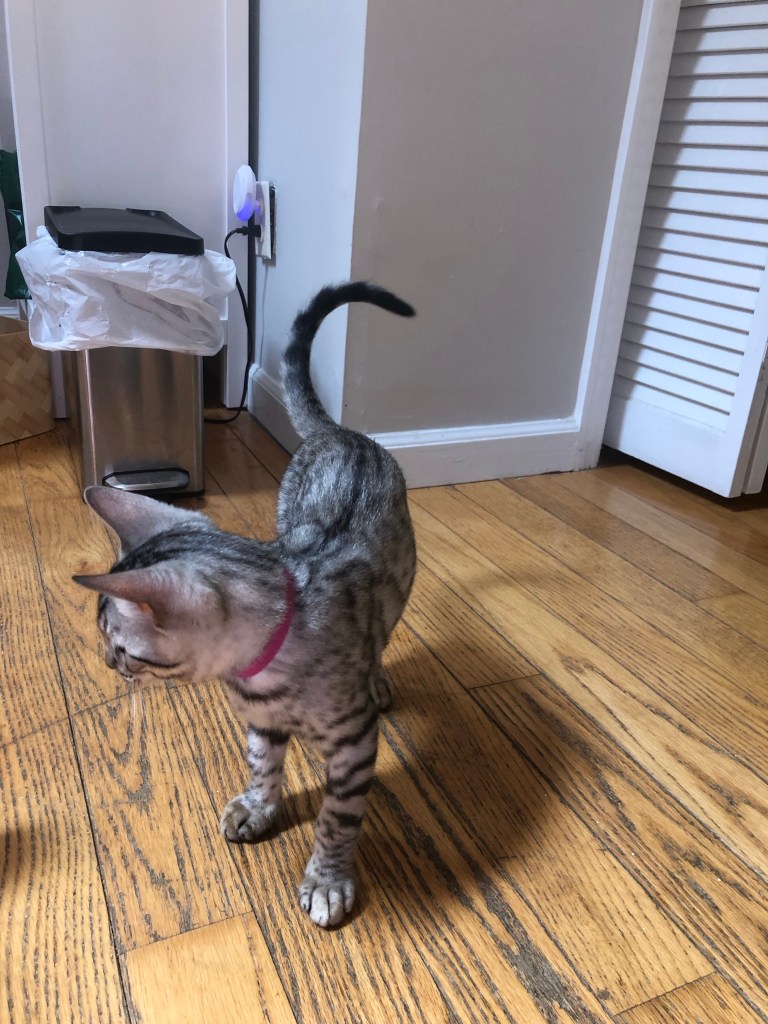
And so Zephyr came to live with us when he was twelve weeks old.
My breeder friend mentioned that the Bengal breed was only 60 years old. When I researched Bengals, I learned that they originated with one woman, Jean Mill, who had acquired a female Asian leopard cat in 1965.
Asian leopard cata
At the time, it was not illegal to own such exotic pets. Mill decided that her leopard cat was lonely, so she got a domestic tom cat to keep the leopard cat company. And the rest is Bengal cat history.
Meanwhile, we are enjoying Zephyr. He’s smart and affectionate. He climbs everything he can. He likes to play with the faucet drips in the tub. And just looking at his beautiful coat gives me tremendous pleasure.
I’m 2/3 through the third book of the series, Long Black Curl. Bo-Kate, the evil challenger to the Tufa leadership, tells her companion that they are members of the Tuatha de Danaan. I’m excited to continue reading and see where Bledsoe takes the story.
P.S. Long Black Curl is not as mysterious and exciting as The Hum and the Shiver. And it’s a lot more violent.
What can I say about this book? I’ve read it at least three times. I love the world Bledsoe creates, full of mystery and magic but set in the present. I suspect that Bledsoe drew on the legend of the Tuatha de Danaan, the magical reace of Irish lore, in creating the Tufa people of his books.(*see the review below)
I’ve scanned Bledsoe’s website and I’ve seen nothing that references the Tuatha de Danaan.
Some sources say that the Tuatha de Danaan, “people of the gods,” or “people of the goddess Danu,” arrived in Ireland on dark clouds. Some say they came as a fog or mist; still other sources say they came to shore in ships. The Tuatha ruled Ireland from 1897 B.C to 1700 B.C., according to the manuscript, “The Annals of the Four Masters.”
Most sources seem to agree that the Tuatha had supernatural powers. They were skilled in art and science, poetry and magic. Bledsoe chooses music as the Tufa’s magical and mysterious power.
When the Milesians invaded Ireland, they drove the Tuatha into the mounds and forests. According to some, they are still there.
There are now six Tufa novels. I’ve only read the first two so far.
*No one knows where the Tufa came from, or how they ended up in the Smoky Mountains of East Tennessee, yet when the first Europeans arrived, they were already there. Dark-haired, enigmatic, and suspicious of outsiders, the Tufa live quiet lives in the hills and valleys of Cloud County. While their origins may be lost to history, there are clues in their music, hints of their true nature buried in the songs they have passed down for generations.
Private Bronwyn Hyatt returns from Iraq wounded in body and in spirit, only to face the very things that drove her away in the first place: her family, her obligations to the Tufa, and her dangerous ex-boyfriend. But more trouble lurks in the mountains and hollows of her childhood home. Cryptic omens warn of impending tragedy, and a restless “haint” lurks nearby, waiting to reveal Bronwyn’s darkest secrets. Worst of all, Bronwyn has lost touch with the music that was once a vital part of her identity.
With death stalking her family, Bronwyn will need to summon the strength to take her place among the true Tufa and once again fly on the night winds…
The Hum and the Shiver is a Kirkus Reviews Best of 2011: Science Fiction & Fantasy title.
After wading through the endless possibilities of purchasing a flight to California, I buy a non-stop ticket to LAX with Jet Blue. I charge it (and the additional baggage fees) on my Capital One Venture card with the intention of using my air miles to pay it off. That is on June 25.
I print out my ticket with my confirmation code and ticket number. And then I check my Capital One account. No charges from Jet Blue show up. Two days later, still no charge from Jet Blue online. A week. Two weeks. No charges.
I call Jet Blue. It’s a challenge to get past all the FAQs and options and find a way to contact customer service and talk to a real person with relevant information. I do, finally, engage in a live chat with someone, who can’t figure out why my credit card account has no record of the booking.
“You have the ticket,” she assures me.
“I’m afraid that I’ll get to security at the airport, and they won’t let me on the plane because I haven’t paid for the flight,” I say.
“Oh, no. Your flight is booked.”
Next, I contact Capital One. Their take on the situation is that Jet Blue hasn’t submitted the “documents” in the requisite five days, so JB should resubmit them.
Back to Jet Blue. “The booking is valid. It must be a software communication problem.”
Every day or two, I check my credit card charges. Nothing from Jet Blue. So I give up.
“Maybe you’ll be traveling for free,” my friend says.
“I was going to pay for the flight with my air miles anyway,” I say.
Almost an entire month later, on July 22, the ticket purchase shows up on my credit card account.
*
Have you ever experienced a similar situation? Drop me a line in comments.
Not long ago, I was listening to a podcast when this phrase, ambiguous loss, came up. I’d heard it before but had forgotten that such a predicament had been identified and given a name. Now here I am, six years into caring for my husband with vascular dementia, still struggling with the same ambiguity and loss.
For those unfamiliar with the term, “ambiguous loss” first appeared in the work of psychologist Dr. Pauline Boss. “Ambiguous loss can freeze the grief process.” says Dr. Boss, “People can’t get over it, they can’t move forward, they’re frozen in place.” ( https://www.wellandgood.com/how-to-deal-with-ambiguous-loss/)
Boss first studied families whose members were pilots missing in action during the 1970s Vietnam War. Ambiguous grief could occur when a family member was physically absent but psychologically present, in cases of military MIAs, divorce, desertion, or miscarriage.
The same ambiguous loss may occur when the member is physically present, but psychologically absent, as with chronic mental illness, dementia, traumatic brain injury, or addiction.
These days, my husband is unrecognizable as the man I met eighteen years ago. I try to recall his personality, his presence, and way of being in the world from that time, and I can’t form a clear picture. He is present in body, slower but still healthy for his seventy-four years. Except he needs so much guidance, so much supervision, so much of my mental energy.
I have passed through many emotions in six years. For a long time, I was enraged. My imagined future, the travels, the freedom of movement, the solitude so necessary for an introvert like myself, evaporated like a puddle after rain. I grieved for those losses, too, and the companion I no longer had.
Only recently, I realized that there were some bright sparks in this life his illness has imposed on me. I can work on my creative projects with little interference. I’ve established a daily routine that works for me, making only two meals for us each day. We have our regular activities with friends. Despite the burdens, these adaptations lighten my load.
Boss recommends ways to cope with ambiguous loss. I’ve done all of them.
Here they are:
Five tips for coping with ambiguous loss:
Give a name to what you’re experiencing
Find a therapist
Join a support group
Celebrate what remains
Discover new hope for the future
Are you a caregiver? Have you any additional tips for those of us dealing with ambiguous loss? Send me a comment.
*
Available from Handersen Publishing and Amazon.com
My plants have fungus gnats, those tiny, irritating insects that drift through the house, drowning themselves in our water glasses or soap dish. At any time of day, someone in the house will suddenly clap their hands.
“Didja get it?”
“Nope.”
For years, I’ve been diligently spraying my house plants’ soil with insecticidal soap. And it worked for a long time. But either I’m not being thorough enough, or the newest generation is immune to the spray.
These little insects, I read, are attracted to carbon dioxide. This explains why they fly into one’s face, and, occasionally, up one’s nose. They lay eggs in the top layer of soil in house plants’ pots. The larvae hatch and burrow deeper, living on decayed matter.
I don’t enjoy killing insects, not even mosquitoes, who adore biting me. Every time I do squash a spider or insect, I think about the Jain monks and their vows of total non-violence. The monks walk barefoot wherever they go to avoid crushing any living thing. They also carry a broom made of woolen threads, using it to sweep away creatures in their path.
I am not so conscientious. Arachnids and insects in the house are either captured and released outside, or killed. The fungus gnats are so annoying that my twinges of guilt last barely a millisecond.
One helpful video advises putting some apple cider vinegar in a little dish. The gnats will drown themselves in it. Also, one can make a triangle out of thick yellow paper (school folder, or paint strip sampler) and coat it with Vaseline. Cinnamon powder on the soil might work as well.
All this pondering on violence to insect life recalled a song from Jim Kweskin’s Jug Band. During my teens, I was a big fan of this band. My idol was Maria D’Amato, the only female member of the group. She played the violin and sang in her husky, sexy voice. She later found fame going solo as Maria Muldaur.
Here’s the link to the recording I used to listen to, and the lyrics. The song itself dates from the 1930s.















 Tangled Magic