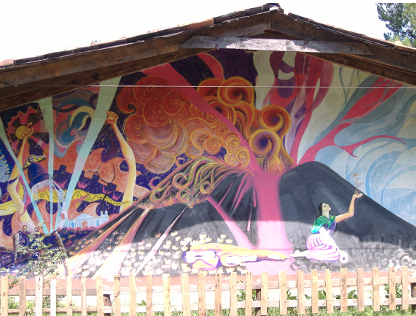
One day in Michoacan, Mexico, a poor farmer named Dionisio Pulido was plowing his field for spring planting. Suddenly the blade of his plow disappeared into a crack in the earth. Smoke poured out of the fissure. In Pulido’s words, “I then felt a thunder. The trees trembled, and it was then I saw how, in the hole, the ground swelled and raised itself two or two-and-a-half meters high, and a kind of smoke or fine dust—gray, like ashes—began to rise, with a hiss or whistle, loud and continuous; and there was a smell of sulphur. I then became greatly frightened and tried to help unyoke one of the ox teams.”
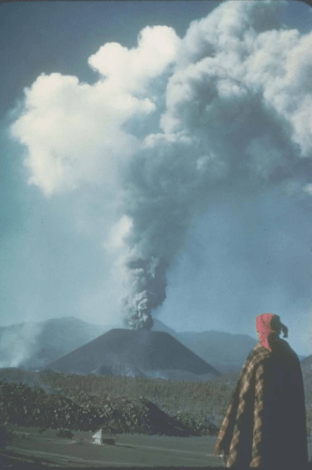
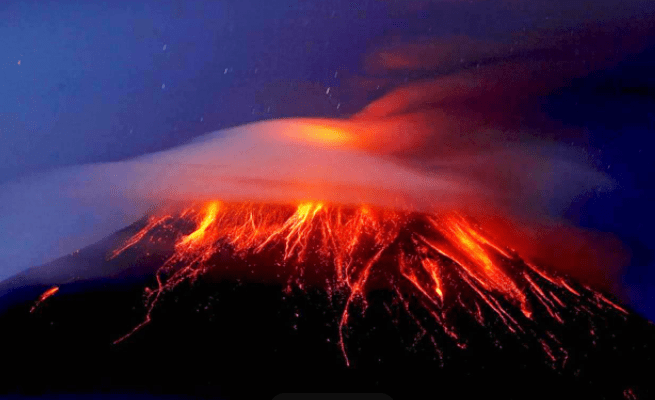
It was February 20, 1943. On this day was born the volcano known as Paricutin. By the next morning, the cone had reached a height of thirty feet and it grew another 120 feet during the day. At night, Paricutin catapulted glowing rocks more than 1000 feet in the air and lava rolled out over Pulido’s cornfield.
Over the next nine years, Paricutin continued its activity. From the level ground of a farmer’s field, the cinder cone rose to its final height of 9.210 feet (2,808 m.) The lava buried the town of Paricutin and partially buried the neighboring town of San Juan Parangricutiro. When the activity ended in 1952, the lava covered about ten square miles.
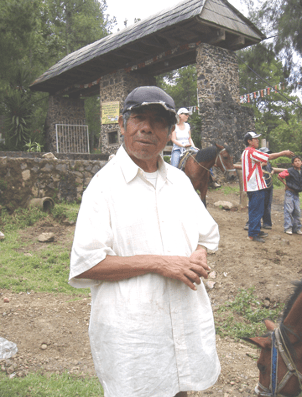
Gavriel, a Purepecha native, lives near Paricutin, in the town of Ahuapan. He was ten years old in 1943. Now, sixty-three years later, he tells the story to my husband and me with sweeping gestures accompanied by sound effects. “La tierra estaba temblando (The earth was shaking). Rumba! Arum! Habia una nube blanca, blanca y grande—en el cielo (There was a white cloud—white and big—in the sky.) Arum! Arum!”
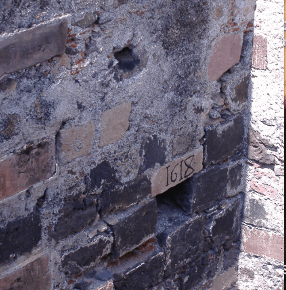
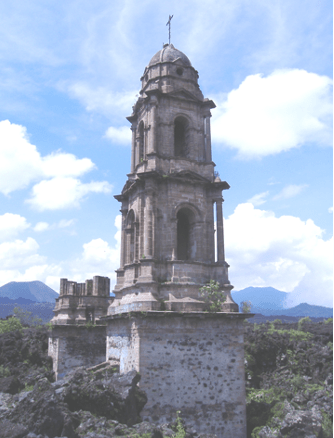
We are standing, Gavriel, Pat, and I, on sharp black lava rocks next to the half-buried church of that once-lively town of San Juan Parangricutiro. Gavriel, our guide and hostler, seems to tremble with remembered terror as he recounts the tale of Paricutin. The dormant cone of the volcano, bare and slate gray, rises in the distance. Not approachable by car, it takes 2 ½ hours by horseback to reach the foot of the volcano. Pat and I have chosen to ride only as far as the buried church. Gavriel points out the date on the church’s cornerstone: 1618.
At age 73, Gavriel is as spry and sure-footed as any mountain goat, leading us over and between the volcanic rocks. Pat follows the old man and I stumble along in the rear, grasping the sharp-edged rocks that look like frozen black foam bubbles. I gaze around me at the ominous claws of lava. Plants have taken root since the last eruption in 1952 and the land is spotted with green. Riding to the church I notice wild berry bushes in profusion, and an abundance of unidentified yellow flowers. Gavriel tells us that there are snakes and lizards, coyotes and rabbits living on the land.
Soon after the eruption began in 1943, the Federales (Mexican police) came to evacuate the citizens of the two threatened towns. Ash was burying the houses; roofs were burning; even their beloved church was succumbing to the fury of the earth. Women covered the mouths of their children with damp cloths, packed up what belongings they could, and the families walked or rode away from Paricutin and San Juan Parangricutiro—forever.
Today all that is left of San Juan Parangricutiro is the half-buried church, its bell tower leaning at a crooked angle.
The altar is visible and remains a place of remembrance and worship. Newly–placed flowers, wreaths and statues stand on the mantle, now partially exposed to the elements. Gavriel urges us to join him where he stands in the church window, a large semicircle that arches over our heads. Below us are the two doorways, one almost filled with chunks of black rock.
Sitting atop a pile of lava, Pat and I rest and I examine our fellow pilgrims. A mother and daughter have made the climb in thong sandals. I’m grateful to be wearing the only pair of closed shoes I brought to Mexico. I’d anticipated warm, dry weather, but thanks to tropical storm Chris and a rainy season, my sandals have remained in the suitcase. These comfy, relatively new shoes will never be the same. They are already scarred with scratches and cuts from the lava.
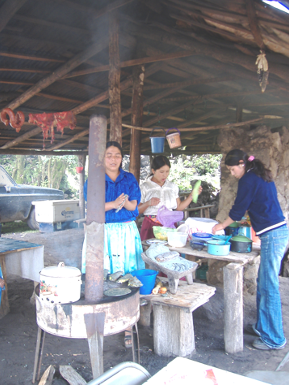
Panting after Gavriel, I keep hoping the old fellow will decide he’s shown us enough. Finally, after a few final photographs of the volcano, we clamber back to the cluster of open air sheds where locals are selling blue corn tortillas and soda. We buy a coke for Gavriel and we all sit for a few minutes. The soil here is black from the volcanic ash. Pungent smoke from the cooking fires mixes with the scent of horses.
I try to remember when I first heard of Paricutin. It was years ago, when I was teaching second grade. One of the guided reading books was Hill of Fire by Thomas P. Lewis. Lewis’s recounting of the story of Paricutin, along with the dramatic illustrations by Joan Sandin, made this book a favorite. My students, always thrilled by natural disasters, often went on to do research on volcanos. One book in particular had pictures of Paricutin at night, the sky aglow with fire. The students were excited to see the photos from which the book’s illustrator took inspiration.
The ride back to the stable seems shorter. My horse turns its head to snap at the pesky flies, and continuously wiggles its shoulder muscles to dislodge the insects. The ability of horses to isolate their muscles in this way is mysterious and fascinating. Gavriel stumps along between us, keeping pace with the horses and never becoming short of breath.
When I slip my feet out of the stirrups and stand up, my thighs are already sore from bouncing on the barely padded wooden saddle. I have also acquired quite a bruise from a misstep that slammed me up against a rock. We settle our bill with Gavriel and mosey over to the restaurant.
Our boletas (tickets) allow us to view a video of Paricutin. We sit in the restaurant, happily eating huevos mexicanos and watching the wild power of our inner earth. Parts of the film are from 1943 with people walking like speedy penguins, gesticulating at the volcano and taking measurements. The more recent part of the video features interviews with eyewitnesses and songs commemorating the tragedy.
Pat and I are doubly at a loss to comprehend the audio since the local native language is Purepecha. The subtitles are in Spanish, so we pick up bits of the story. It is enough just to see the weathered brown faces of the villagers as they tell their tales. The interviews alternate with shots of the erupting volcano, rocks hurling down its slopes.
This visit to a volcano has turned out to be a surprise literary pilgrimage. It is a strange feeling to be in a place that is familiar because of a children’s book. I remember when Pat and I were studying the map of Michoacan two weeks earlier and I recognized the name of Paricutin. A children’s book from many years past linked me to this place of awe and beauty.
This article is updated from the original written before I retired from teaching ENL.
*
“Go home,” said Juan.
To me.
Those two words made me feel sick at heart, rejected, and devalued. After days of planning lessons and gathering materials, after four weeks of driving 80 miles to Middletown and back during my summer vacation, after four weeks of orchestrating writers’ workshop for this group of middle school students, those two words were my feedback.
“What can we do to improve the program?” I had asked the students on the last day of Young Writer’s Camp.
“Go home,” said Juan.
Two months later, I heard those two words again, this time from a teacher. They were spoken during a workshop on English as a New Language (ENL) that I was co-presenting to middle school teachers in my school district. My colleagues and I had composed several fictitious profiles to illustrate the varied backgrounds of our English Language Learners (ELLs). One of the teachers read this profile:
Profile II: Beginner
Anton
I am a refugee from Afghanistan. We left two years ago. My father is still there. I live with my mother and four brothers and one sister here in Highland Mills. None of us wanted to leave our country. I miss my father so much and I worry about his safety. I can speak English in short sentences using functional vocabulary. I am literate in my first language. I don’t want to be in the U.S., and I am not motivated to learn English. Because my mother leaves for work early in the morning, my brothers and I often sleep late and miss the bus. We hate everything here and we want to go home.
“So go home,” a male teacher called out.
Some people laughed. I felt heartsick again. Surely this teacher’s attitude was communicated to his ELLs, our students.
Now, I’d been a teacher for many years. I knew the extra pressure that fell on a teacher with one or more ELLs in his or her class. Often, teachers were already overwhelmed by the daily demands of our jobs. I knew what it was like to deal with students who would rather be anywhere but in school. That kind of resistance from a recent immigrant seems to smack of ingratitude, never mind the additional attention required from teachers to repeat directions or adjust assignments.
I didn’t know if the teacher who called out was a willing, interested member of the workshop, or if he was just enduring another in-service day. Whatever the teacher’s story when he yelled, “Go home!” I was on the verge of responding aloud. I remained silent, but what I wanted to say was, “Yes! That’s it exactly! Anton wants to go home. But the point is that he can’t. He’s just a kid, subject to the decisions of adults who believe they know what is best for him.
“So what areas of his life can Anton control? He can control his life at school. He can choose not to like school, not to learn English, not to like the United States. From Anton’s point of view, acquiescence would only distance him further from his father. Maybe, for Anton, there is no home to go back to, just a pile of rubble that used to be his neighborhood.”
Pondering the lives of today’s immigrant students, I wonder how their experiences compare to those of my aunt Helen. She passed through Ellis Island around 1900. Did someone ever tell her to go home to Poland, where the Jews were being corralled in ghettos or victimized by pogroms? Did the teachers at her public school in New York City make her feel welcome or unwanted?
The greatest teacher I know begins all her talks with these words, “With great respect and love, I welcome you all, with all my heart.”
When we welcome someone, we give that person value and recognition. Welcoming is an invitation to belong, to be included. Welcome offers warmth and generosity. It says, “Share with us.” Often coming from difficult situations, our ENL students want and need to feel welcomed. Unfortunately, that’s not always the case. Some teachers perceive an ENL student as an added burden.
When I taught ENL, my first duty was to look in the mirror. Was I welcoming my new students? When a new child registered and joined one of my already crowded groups, did I make her feel safe and included, or did I project an attitude of exasperation that communicated, “Go home”?
It’s not always easy for teachers to find the time and energy to make a new ELL feel welcome. To welcome a new student with respect and warmth is surely no more than we would want for ourselves, or for our own children in a foreign land.
Satya lives in this house, but it is not her home. Right now her home is two continents away, in a dusty village, with him. He’s probably eating his evening meal of rose-flavored yoghurt and a mango. Wherever her teacher resides, Satya’s home is in that place, at his feet.
It is not yet dawn in the Hudson Valley. While her daughter, Devi, her heart’s delight, dreams gently in the bedroom across the hall, Satya lets her soul fly home, to the hut beside the temple, and there he is.
He feels the presence of her spirit and greets her with a wide smile, even though his eyes are closed. The evening meal is over. Others have come to sit in the presence of this man. The silence is alive with his energy. Satya allows her astral body to rest in the love pulsing from her teacher.
His white hair seems incandescent; his high cheekbones rise above the full beard. He is wrapped in a blue shawl, sitting on a folded white wool blanket.
When her dogs begin to bark, Satya’s soul sails back through the dark and light of half a day, back into her body of muscle and bone. It feels at first like she has put on a suit of armor, cold and unyielding. She cannot move her fingers; she must consciously tell her heart to beat faster. The dogs lick her hands; their warm tongues and worry have her eyelids opening. Satya stares up at the pale blue ceiling. Tears trickle from the outer edges of her eyes. The longing is always the worst of the pain.
“Here I am again,” she thinks. “Still such a long, long way from home.”
My first brush with the practice of Ho’oponopono occurred in 2015, at the Cayce Association for Research and Enlightenment (A.R.E.) in Virginia Beach. One of the workshop presenters, an Energy Medicine practitioner, mentioned it. I suppose I stored the seed away in my mind somewhere, and now it has begun to grow.
Recently, the reverend and practitioners in Agapeeast.org (part of Agape International Spiritual Center), whose classes and services I attend online, spoke of the power and usefulness of the short Ho’oponopono prayer (I’m sorry—Please forgive me—Thank you—I love you).
For quite a while I had been feeling flat during meditation, with no recognizable sense of Spirit. Reverend Victoria of Agapeeast taught the Ho’oponopono prayer. Several students in the class mentioned that it was their “go-to” prayer when their upset was too great to focus on any other method of prayer.
The continued stress of the COVID threat added to family troubles led me to try Ho’oponopono. What an experience! I found focus, ease, and peace in repeating the prayer. It’s been about a week since I’ve used the prayer instead of my traditional mantra. Now I look forward to each meditation session, extending it to forty minutes if the daily schedule permits. It’s like sinking into a scented, warm, cleansing bath. I recommend giving Ho’oponopono a try.
The prayer comes from Hawaiian tradition. Morrnah Nalamaku Simeona, a Hawaiian Kahuna (the one who guards the secret), adapted the practice for anyone to master and apply.
To learn more about her, the history of Ho’oponopono, and the technique, go to:








 Tangled Magic