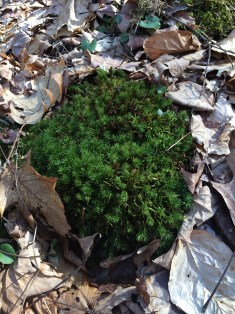
Walking in the woods today, I found greening star moss.
A yellow crocus . 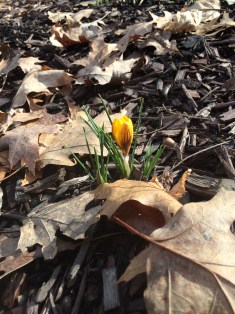
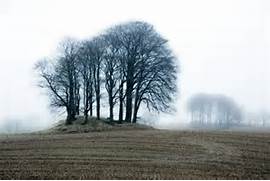
And a faerie castle.
Walking in the woods today, I found greening star moss.
A yellow crocus .
And a faerie castle.

March 2017

Nathaniel Hawthorne, the young hero in Hansen’s book, confronts the greatest adversary of all time: Mr. B., the Devil himself. The story takes place in a small community theater in the Midwest, where Nathaniel helps his Aunt Misty put on performances. When Mr. B. joins the company, he is, of course, an excellent actor. However, Mr. B. has higher aspirations: to rule the world. It is up to Nathaniel and his friend, Keisha, to stop him.
With Nathaniel, we watch plays performed, and make a short visit to Hell where we meet the current Seven Deadly Sins. Author Hansen manages to sneak in a lot of interesting information about plays, their production, and Mr. B.’s various appearances throughout human history.
I particularly liked the end of this book, because it surprised me. It wasn’t your typical happy ending, that’s for sure. But maybe that made the conclusion more satisfying.
Hansen is the author numerous books and short stories and an editor for Stinkwaves Magazine and Handersen Publishing. He also happens to be my editor for the Magic Trilogy.

The kelpie, a water spirit in Scottish legends, lives in streams and rivers. Some sources say kelpies also haunt lakes and seas. The kelpie is a shape-shifter who can appear as a beautiful horse or a lovely woman. In her horse guise, she lures people onto her back, and then dives deep into the water, drowning the rider.

Kelpies warn of approaching tempests by wailing and howling, and continue their chilling cries throughout the storm.
One can only tame a kelpie by taking possession of its bridle. Then the kelpie must submit to the owner’s will. Kelpies are strong, and can do the work of ten horses. However, capturing and mastering a faerie spirit like a kelpie is a dangerous undertaking. I wouldn’t recommend it.

Today I made my first attempt to leave gifts for the faeries.
I read that faeries like sweets, cream, butter, pretty stones, and shells. Hunting in my craft supplies and my fridge, I found some of these items.
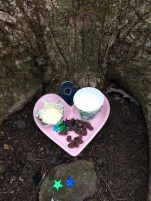 Faerie gifts: butter, cream, raisins, a slice of turquoise agate.
With my heart-shaped plate of faerie goodies, I went down to the stream behind our house. A hollow at the base of a tree seemed like a good spot. I brushed away the leaves, and set up my offerings.
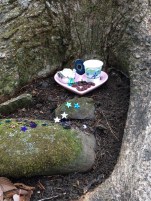
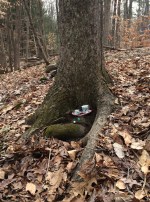
I also read that there are special chants or songs to sing when offering gifts to the faeries, but I didn’t prepare any. The faerie gift hollow is going to be a work in progress.
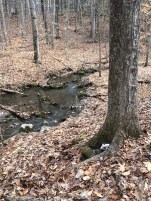
Tomorrow I’ll check to see what happened.
Our house sits on the edge of woods. Behind the house is a creek. These days, I can hear its rush and gurgle all the way from my front door.
In the puddles among the soggy leaves, the skunk cabbages are pushing up their striped heads.

On a slim, dead tree, I found little ruffles of fungi.
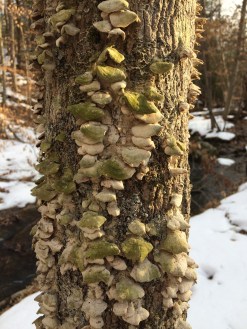
This is my favorite time of year to follow the stream and observe all the new beginnings.
February, 2017
When an author comes to visit at a school, kids often ask, “Where do you get your ideas?”
My best ideas come when I’m sitting quietly, doing something that’s not related to writing, such as sewing, taking a shower, or cooking. But the story that I’m writing is always alive in my mind. We writers call this “percolating.”
Maybe you’ve been given writing prompts at school. Writing prompts are a good way for writers to get into a story.
In my book Tangled in Magic, Malcolm learns how to throw sparks from his fingers. What magic power would you choose to have?
Here’s a writing prompt for you to try:
You (or a character) have a magic power. What is your magic power? What might you do with it? And what happens then?


Illustration by Alison Gagne Hansen
Archer, the gyrfalcon, is one of the main characters in my book, Tangled in Magic. She is intelligent, opinionated, and sometimes sarcastic. When Agatha flees Underhill Manse to search for her brother, Archer insists on accompanying her. She proves to be a helpful, reliable companion.
The gyrfalcon’s natural habitat is the Artic coast and tundra, where its plumage is white with black markings. The largest of the falcons, gyrfalcons prey on ptarmigan and waterfowl.
(February, 2017)
Recently I began reading my way through the Newbery award winners. Each year the Association for Library Service to Children awards the Newbery Medal to
“…the author of the most distinguished contribution to American literature for children.”
This award began in 1922, with the first Newbery Medal winner, which was The Story of Mankind by Hendrik Willem van Loon. I may check this one out, if it’s still in print. It sounds like a textbook, though, doesn’t it?
If you’re interested in finding out which books won this year, go to
http://www.ala.org/alsc/awardsgrants/bookmedia/newberymedal/newberymedal
I read The Wednesday Wars by Gary D. Schmidt, a 2008 Newbery Honor Book (published by Scholastic).
Confession: I take life far too seriously. When I find a book that makes me laugh out loud, I consider it a treasure. The Wednesday Wars is funny. It’s also a little hard to believe, especially the part about the rats. Still, I love the voice of our hero, Holling Hoodhood, and his hilarious progression through seventh grade at Camillo Junior High on Long Island, N.Y.
All the kids in Holling’s class leave school early to go to religious studies. All except Holling, who is left alone with Mrs. Baker, his English teacher. She assigns Shakespeare’s play, The Merchant of Venice for Holling to read. What a surprise for Holling! He actually enjoys Shakespeare.
Schmidt cleverly weaves a story that includes the current events of 1967, including the Vietnam War, and the assassination of Martin Luther King, Jr.
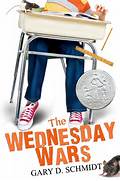
This book is so good that I might even read it twice!
What are you reading? Send a comment and let me know.
The Origins of Faeries
Where did faeries come from? One theory suggests that they were the Tribes of the Goddess Danu, or Tuatha de Danaan, a seafaring people who lived near the Aegean Sea. The Danaans were a magical race, and adept at blacksmithing. Invaders drove them northward, out of Greece, and eventually they arrived in Ireland.
The legend says that the Danaans came to Ireland on a ship of dark clouds. They brought with them three treasures: the stone of destiny, the spear of Lugh, and the sword of Nuada (Light).
More than two centuries later, when the Milesians invaded, the Danaans retreated into the hills and mounds (sidhe). They made their homes in raths (circular enclosures surrounded by an earthen wall), invisible to human eyes.
Thus, the Danaans became the faery folk of Ireland, also called “aes sidhe” the people of the mounds, or the “grey ones.”
The Bunyip
The bunyip is a creature from Australian Aboriginal legends. Its name means “devil” or “spirit.” According to the legend, the bunyip is a water monster that lives in rivers, swamps or billabongs. The early Aboriginal drawings depict the bunyip as a beast with a horse tail, tusks, and flippers.
Said to be nocturnal, the bunyip comes out of the water to snatch and eat all kinds of animals, including women and children.
The bellowing cry attributed to the bunyip could also be the calls of other animals, like the koala or barking owl.
Is the bunyip real or imaginary? You decide.
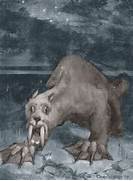
Image from planetetheria.com
(A bunyip appears in my book, Pursued by Magic)
 Tangled Magic