Mirror

Photo by Ray Bilcliff on Pexels.com

We stand on a cliff

in blasts of wild wind.

Above us, charcoal clouds

boil and bulge.

Below us, the furious sea

mirrors the raging sky

that churns and heaves

as it engulfs two houses.

*

He is someone I knew in high school.

He says, we’ll take a boat

when the storm ends.

No, I mutter,

sure that the waves will still be high

and seasickness a certainty.

The wind snatches my pale voice.

*

And why is he in charge?

And why don’t I shout my refusal?

And what is the reason

for such a risky trip?

*

My mirror asks,

what is your purpose?

My mirror says,

you are bigger than this small life.

My mirror says,

you can choose your boat.

You do not have to enter

drowning houses.

*

Available from Amazon and Handersen Publishing

Saying Goodbye

Photo by cottonbro on Pexels.com

(This piece of writing comes from 2007, during my days of teaching English as a New Language (ENL–once called ESL). Working with these children and their families was my delight and good fortune.)

On the second-to-last day of school, I give my English Language Learners (ELLs) in first grade a farewell party.  We have mini-muffins and fresh strawberries.  For Anton, I bring a peach pie. 

“I never taste pie,” he said a few weeks ago when the word came up in our lesson.  “What pie?”

 We told him it was made with fruit and a crust.  He didn’t forget about the pie.  When I told the first graders we’d be having a last day party Anton perked up.

“You bling pie for we eat?” he asked me.  Along with ESL classes, Anton is getting help from the speech teacher for his articulation.

“OK, but I probably won’t bake it myself,” I said.  At the end of the school year, I am weary, as well as inundated with paperwork.  I know for sure that homemade pie is not going to fit into my schedule.

On Thursday, Pie Party Day, I give the students some free time to play games or draw.  Our daily classes are usually crammed with lessons; there’s so much to learn about speaking, listening, reading and writing in English.  On this day, I kick back and have relaxed conversations with my kids.  

I call them “my kids.”  You would probably call them my students.  Most of them I’ve known for two years, and one has been with me for three years.  In any child, the change from a frightened five-year-old entering kindergarten to a cocky seven-year-old heading into second grade is astounding.  But my kids—my kids—make enormous changes.  To me, this metamorphosis is as miraculous as whatever goes on inside a chrysalis.  Only I get to see it happen in a way that regular classroom teachers don’t, because my job is truly special.

 I’m a teacher of English as a Second Language (ESL) and my skinny classroom that was once a storage closet is a safe haven for many bewildered, anxious children, children like my Leticia.  Three years ago, when she trustingly took my hand and walked with me to our ESL classroom, Leticia was tiny, even for a kindergartener.  She spoke no English at all and had not attended preschool.  She spent her first five years in the constant company of her mother and loving relatives, none of whom spoke English.  I remember being struck by the great courage of this small person.  How very brave to spend hours every day in a place where no one speaks your language, where there is not one familiar face.

Today Leticia is a leggy, confident first grader who reads well and converses fluently in English.  Many songs and language games later, here she is, able to move back and forth between two languages.  How many adult Americans can do that? 

As we eat our muffins and pie, I ask what everyone is doing for the summer.  Anton speaks first.  “I go to Uklaine.” He bounces with happiness and his straight, blond bowl cut hair bounces with him.  “I go see my glandma and glandpa.”

Alberto of the bright, mischievous chipmunk eyes tells us he is going to Mexico.  “I’m going to my uncle house in Puebla.  He take care of my dog.”

Kenny, whose glasses are always slightly askew, is going to visit his Filipino cousins in California as soon as school lets out.  “We’re going to eat crab at the beach!  I love crab!”

I can’t believe I won’t see my kids again in September.  They will be new second graders, learning the layout of a new school.  I’m worried about them.  How will they manage the tougher curriculum?  Will their new teachers help them with unfamiliar vocabulary and explain science concepts? 

In our ESL classroom, we have a photo album full of pictures of our school year.  There’s Noodle Day when we ate with chopsticks while practicing restaurant vocabulary and ordering from a menu.  There’s Rice Day when we researched and wrote a book about rice.  There are pictures of the kindergarteners dressing for the weather in my family’s oversized raincoats and snow boots.  There’s Rani, with her birthday crown; showing her gap-tooth smile.  She’ll have her grown-up teeth by September.

On the last day of school, it is tradition for all the teachers to gather on the grassy bank by the bus parking lot.  We wave goodbye to the students as they leave for the summer.  In my seventeen years of teaching second grade, I always felt a sense of relief as the buses honked and pulled out on to the road.  During the ten months of school, I usually enjoyed my students, but I wasn’t sad to say goodbye until I started teaching ESL.  This year I am already missing my kids.  This year I see those beautiful children’s faces pressed against the school bus windows and my eyes fill with tears. 

Photo by Anastasia Shuraeva on Pexels.com

*

Available on Amazon and from Handersen Publishing

Green

Photo by Felix Mittermeier on Pexels.com

Artichoke green

shadows of pine trees

dark with hints of yellow

where the grackles congregate

*

Fern green

maidenhair and fiddlehead

canopy for voles

dew-drop shower

*

Forest green

hillside jewels

gathered there

locust, maple, oak, pine

*

Honeydew green

melon sweet,

pale as pith

sun ripened

*

Jungle green

touched by blue

cattails and clover leaves

cucumber peels

*

Kelly green

meadows between stone fences

clouded by sheep

floating over stiles

*

Mantis green

rare creature who prays

while stalking beetles

on summer branches

*

Mint green

aphids or katydids

nasturtium circles

tremble in wind

*

Tea green

lightly steeped

jasmine steam

a porcelain cup

*

Celadon green

pale and gray

a range of sad shades

resembling jade

Welcome, new followers! Thank you for reading!

Labyrinth IX

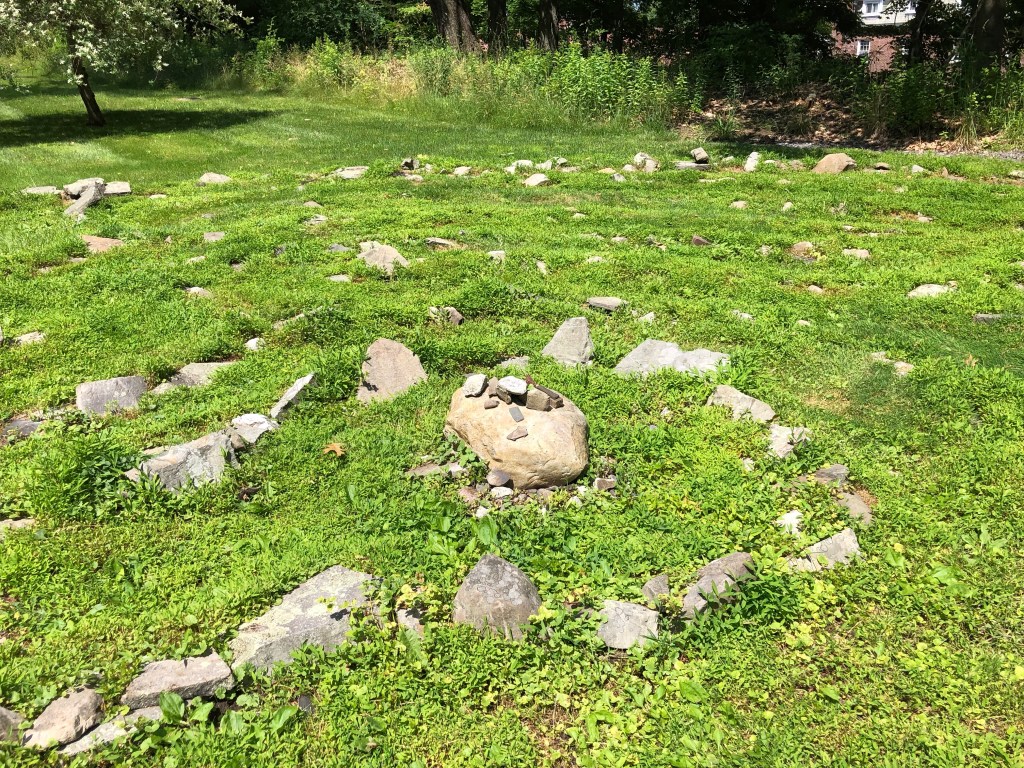
The labyrinth at Holy Cross Monastery in West Park, N.Y. is not listed on the Worldwide Labyrinth Locator site.  I found out about it because one of my writer friends is a monk who lives there.  “Oh,” he said after I mentioned my labyrinth quest in our writing workshop, “Holy Cross has a labyrinth.” So on a hot and humid afternoon, my husband and I hopped into the air-conditioned car and went exploring.

My GPS sent us on a picturesque but indirect route to the wrong part of Route 9W.  We backtracked a little on 9W and eventually found Holy Cross’s curving drive that led to a large parking lot.  When I slowed down to reconnoiter, I recognized the familiar pattern of stones set in the lawn on the far side of the parking lot.

The Holy Cross labyrinth is an eight-circuit medieval style labyrinth. 

This is a seven circuit medieval labyrinth design. (It’s possible I miscounted at Holy Cross.)

There’s a small cairn marking the entrance and another in the center. 

The stones that  form the circles are larger than those of any other labyrinth we’ve seen.  Most of the rocks were the size of a football (American) or larger.  There appeared to be weed-blocking cloth under the whole labyrinth, but the grasses and weeds had grown through.  They formed a pleasant, cushy walking path. 

I picked out an attractive stone of gray and white to mark my passage, and started off on the path, repeating the comforting mantra, “All is God.  All is well.”  In the center, I placed my stone on the top of the cairn, adding it to several already there.

We saw nobody during our visit.  A small, barn-red house beyond the labyrinth appeared to be occupied, maybe by a groundskeeper.  Opposite the labyrinth was a stone path leading to the imposing monastery itself. 

We paused to appreciate the trees and the quiet, and then we left.  I believe no one knew we had come.

Indenture

Photo by cottonbro on Pexels.com

7:00 – she’s tucking in the sheets

that the four-year-old kicks loose every night

            the seven-year-old sleeps like roadkill

            the baby, of course, sleeps next to her

            she hears a creaking click

            is that the flap on the mailbox?

            she hurries barefoot downstairs

            holding her nightgown above her ankles

            Nothing.

*

9:30 – she vacuums the rug in the foyer

            her starched collar scrapes her neck

            one eye on the carpet

            one on the mail slot

            Nothing.

*

11:00 – she puts the roast in the oven

            scrubs stains out of mister’s overalls

            wipes her raw fingers on a tea towel

            Oh! Footsteps on the front porch

            clink-clack goes the flap

            crisp envelopes slide onto the mat

            an invitation for the missus

            two bills for the mister

            one beautiful blue aerogramme

            that she kisses

            and presses to her heart

Labyrinth VIII

Labyrinth VIII

The Lifebridge Sanctuary in High Falls, N.Y. holds a special place in my heart because my daughter had her wedding there more than a decade ago.  She got married at the end of January, so the scenery was quite different than what we saw this June when we went to check out the labyrinth. 

Lifebridge rests in a mountain setting.  It serves as a retreat site and hosts other events, too, such as weddings.  The labyrinth is indicated by a small sign.  It is a classical or Cretan style labyrinth, made with stones that were collected by the builders (see the explanation in the photo).

The weather was perfect: cool and sunny with just the right amount of breeze.  Except for the wind, the hillside was silent.  We walked the path, but I had trouble discerning the center.  This design is not my favorite.

Cretan or classical labyrinth

 I prefer the Chartres style with the six-petaled rose in the center.  It has more mystery and destination, and it offers more space in which to stand.

However, once we’d completed the labyrinth, we sat on a bench and soaked up the peace.  I wanted to stay there for hours, basking in the pleasance and beauty, but it was Sunday and Lifebridge was closing.  This labyrinth is in such a lovely location that it rivals the richness and peace of the labyrinth at St. James in Hyde Park.

35,000 Feet

Photo by Jou00ebl Super on Pexels.com

He climbed into the jet’s wheel well

in Havana.

In June, 1969, he was seventeen.

The Iberia Douglas DC-8 flew

non-stop

to Madrid.

Why Madrid?

All the other flights

went to communist countries.

*

He held on by his fingertips

during take-off.

The wind blew him sideways.

He became part of the noise.

The deafening blackness.

*

He shivered and shook

in freezing air

at minus thirty degrees.

Deprived of oxygen

he passed out.

*

The pilot found him

under the plane.

Presumed dead,

covered in ice.

*

Armando Socarras Ramirez survived.

Like a hibernating animal

he returned to life

in the warm Spanish air.

*

128 wheelwell stowaways

since 1947,

all males

driven by desperation

risking everything.

Labyrinth VII – Unification Theological Seminary

Our labyrinth hunt is taking us further afield.  The Unification Theological Seminary (UTS)—unknown to me before this trip—is situated almost an hour away on the east side of the Hudson River, in Barrytown.  The buildings are fairly impressive; the grounds are well-kept and beautiful.

In the first parking lot, we stopped a couple getting ready to hike who directed us up the road.  “The labyrinth is on the left,” the man said.  Of course, we missed it and ended up driving around the site, eventually passing some homes.  Two people and a dog were out in their garden, so we asked again.

From the way he spoke, the man seemed to belong to the place.  “We’re fixing it up,” he said of the labyrinth.  “Some of the bricks have sunk into the ground.”

Following his directions, we managed to find it.  After the peace pole, we spotted the overgrown labyrinth.  The entrance is marked by a pretty, vine-covered gate.  And yes, the bricks are buried and yes, it was so hard to discern the paths and turns that I eventually gave up. 

However, I spent a happy half hour swishing through the weeds, looking hard for the switchbacks, and reading the signs posted at the four compass points and in the center.  And for all that walking, I only found one tick on my white pants.

This labyrinth is an eleven-circuit one in the Chartres cathedral style.  It’s big, eighty feet in diameter.  Over on one side is a memorial bench. 

Once we got back to the car, we explored other monuments.  I was getting the drift that this place had a long history, and I was curious to look it up online later.

We met the hikers again and learned that the UTS was founded by Sun Myung Moon.  That name sounded familiar, but I couldn’t remember anything about him. 

Here’s the UTS profile from its website (https://uts.edu/about-uts/profile-of-uts):

The Unification Theological Seminary [UTS] prepares its graduate for professional careers in the ministry and in public leadership. UTS serves as the Home of Thought for the teachings of Unificationism. While at UTS, all students master the teachings of Christian tradition and learn about the core underpinnings of the World Religions. UTS confers four accredited graduate degrees: Doctor of Ministry, Master of Divinity, Master of Religious Education and Master of Arts in Religious Studies.

UTS has a gifted, respected faculty from differing religious backgrounds and denominations. UTS fosters an ethos of faith and of living for the sake of others. The seminary’s more than sixteen hundred graduates serve in a broad array of missions in the church and in public leadership. Many go on to pursue careers in interfaith organizations, in education, journalism, law, medicine, politics and business. UTS graduates have gone on to pursue doctoral studies at Harvard, Yale, Princeton, Chicago, Columbia, Vanderbilt, Graduate Theological Union, and other top educational institutions.

Apparently, UTS is still viable, but classes are currently held online.  And yes, it was indeed founded by Sun Myung Moon. This part of the UTS history is from the same website:

Less than three years after he began his ministry in the United States in December 1971, Reverend Moon initiated plans for the establishment of his young church’s first theological seminary. For this purpose, in 1974 the church purchased the campus of St. Joseph’s Normal Institute, a Christian Brothers boarding school located in the Hudson Valley that had recently closed. Dr. David S. C. Kim was appointed to establish the Seminary and lead it as its first president. President Kim assembled a faculty and staff, and on September 20, 1975 UTS welcomed the first class of 56 students, who enrolled in a two year Religious Education Program. In 1980 the Seminary added a three year Divinity Program to better prepare students for ministerial leadership.

Sun Myung Moon’s biography is surprising.  Here’s an excerpt from The Guardian

( https://www.theguardian.com/world/2012/sep/03/moonies-sun-myung-moon-dies )

Moon founded the church in 1954 amid the ruins of South Korea and promoted a mixture of Christianity and his own conservative, family-oriented teachings. He preached new interpretations of lessons from the Bible, and fused elements of Christianity and Confucianism – outlining his principles in his book, Explanation of the Divine Principle, published in 1957.

In later years, the church built a business empire that included the Washington Times newspaper, the New Yorker Hotel in Manhattan, Bridgeport University in Connecticut, as well as a hotel and a car plant in North Korea. It acquired a ski resort, a professional soccer team and other businesses in South Korea, and a seafood firm that supplies sushi to Japanese restaurants across the United States.

Moon seems to have made some questionable moves in his long life.  However, the Seminary appears to be an accredited college that has hosted, in its past, many illustrious speakers.

At the end of our visit, we had not only found a labyrinth and a lovely place, we’d also had our curiosity piqued and learned some new history.

In Book III, Awakening Magic, Prince Emric must avert a war by relocating the faeries’ labyrinth.

Accord

Photo by Felix Mittermeier on Pexels.com

What is more optimistic than a maple tree?

Who else produces a myriad of mini-helicopter children

only one of which might—possibly—take root?

*

What is more reassuring than a river?

Its destination fixed, conversing with itself

and anyone else who cares to listen,

always, always running to the sea.

*

What is more adaptable than poison ivy?

Who else appears in so many guises?

Masquerading as a vine, it climbs

toward the light.

At ground level, it sends runners in all directions,

covering an area

the size of a car, two cars, a parking lot.

It says, go on, touch me.  I dare you.

*

In the dream, I had two black snakes in a box.

They pushed off the lid,

so I took them into my hands.

Oh, the feel of the smooth, cool scales

coiling around my wrists,

sliding through my fingers.

I took them under the maple tree

and let them go.

Labyrinth VI – Fair Street Reformed Church

My husband needed a COVID test at his doctor’s office in Kingston (NY).  So…as long as we were in Kingston, I thought we might as well check out the labyrinth at the Fair Street Reformed Church.  Fair Street is in the old part of Kingston with interesting houses that probably date back to earlier days when Kingston was the capital of New York. 

The labyrinth was just steps away from the sidewalk.  The bricks outlining the path appeared to be made of granite and were slightly above ground level.  There was a plaque at the entrance with some suggestions, including this provocative quote:

The point of a maze is to find its center.  The point of a labyrinth is to find your center.

This labyrinth had six circuits and was medieval in type, according to the WWLL.  The placement of the bricks that formed the circuits was clever.  The turns were formed by an elongated X.  I especially liked the way the bricks formed the six-petaled rose in the center.  As far as I could tell, the only bricks that had to be cut were those that made the end points of the petals’ edges.

For all its simplicity—or maybe because of it–this design was really pleasing.  However, the paths were a little too narrow for comfortable walking.  I suspect the location dictated the width, because the labyrinth was on the lawn between the church and the sidewalk.

It was hard to find inner silence on that busy Monday morning in the center of Kingston.  I was halfway into my walk when along came a city worker with a rolling metal cannister, collecting the money out of the parking meters.  Oh, the rattling and clinking! 

It wasn’t a peaceful location—for me, anyway–but I will store away the design as one to possibly replicate someday.

*

Book V, Growing Magic, available soon from Amazon or http://www.handersenpublishing.com